A tale of two investors
On a cold Monday morning in January 2000, two investors sat down at their kitchen tables. They each had $100,000 to invest.
The connection between coal-fuelled Nazi fighters & today’s diesel crisis
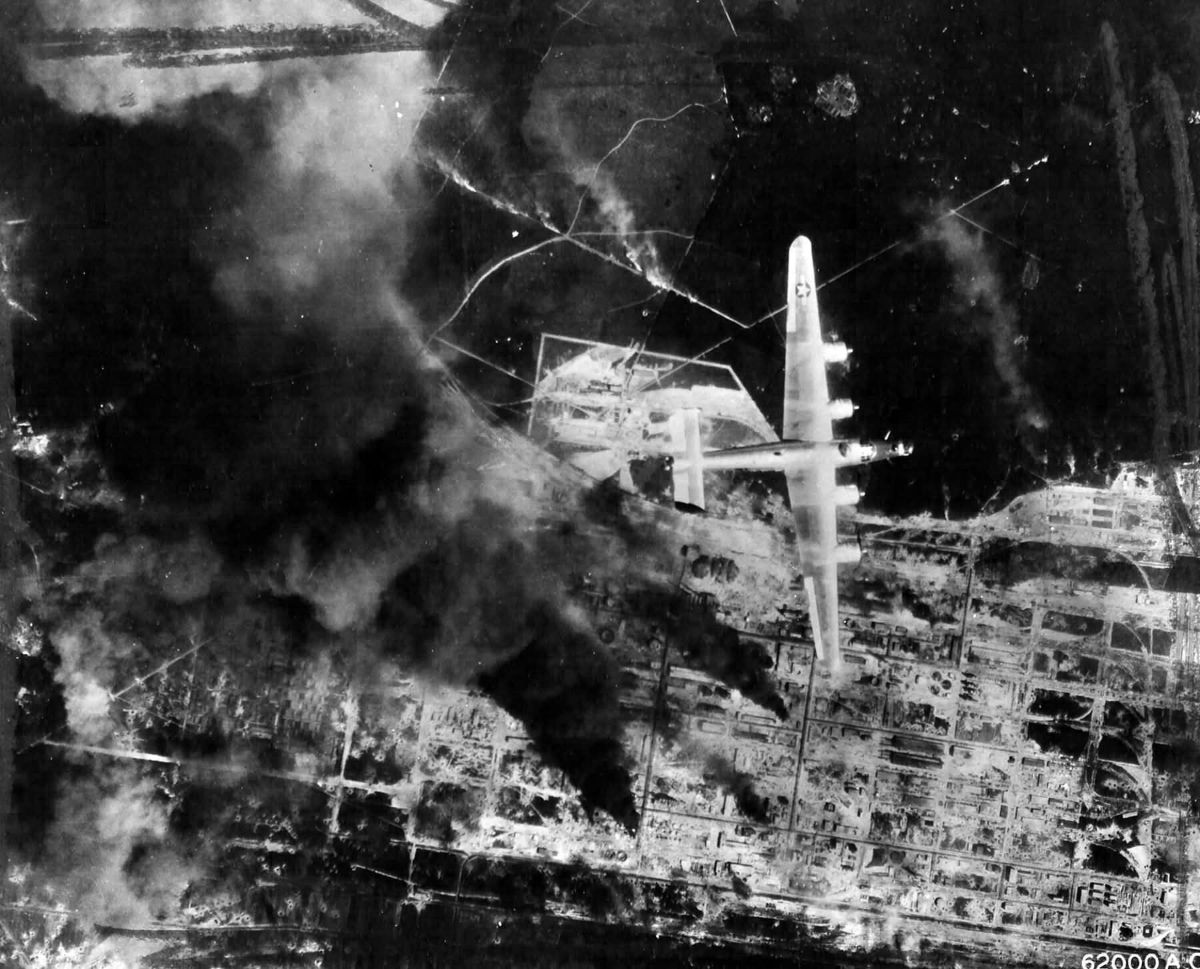
On May 12, 1944, the US Eighth Air Force flew bombers into central Germany with an unusual target list.
Not cities. Not airfields. Not tank factories.
But rather, chemical plants.

The largest such plant sat beside the small town of Leuna, near Leipzig.
Germany had a problem it had been trying to engineer its way out of since the 1920s.
It had almost no oil of its own.
But what it did have was coal. Mountains of it, in fact.
So German chemists worked out a way to turn one into the other. If you grind the coal, force hydrogen into it under enormous heat and pressure, you get liquid fuel.
Leuna had been making this synthetic fuel since 1927.
By 1944, a network of these plants was producing about 75% of the Luftwaffe's aviation fuel.
Which meant the Messerschmitts fighting over Europe were, in effect, flying on coal.
Until that spring, the Allies had mostly bombed other targets. Only about 2% of their bombs had been aimed at Germany’s oil industry.
Their new bombing approach inflicted brutal damage.

Albert Speer, Hitler's armaments minister, later wrote of that first raid on May 12: ‘On that day the technological war was decided.’
But here’s the part that matters for what’s happening in the fuel market right now:
Germany never ran out of coal. Its enormous Ruhr and Silesia deposits remained in the ground.
It just couldn't be used. The plants that turned the coal into fuel were ruined.
So the raw material was never Germany's weak point. The conversion step was.
Eighty-two years later, the West is learning the same lesson. Only this time, the West didn’t wait for the bombers. It closed many of its plants itself.
Plenty of crude, not enough diesel
On September 14, US diesel futures hit a record $118.62 a barrel above the price of crude oil, according to Reuters.
That gap is called the crack spread, after cracking, the process of breaking crude down into lighter fuels.
It's the difference between what a barrel of crude costs and what the fuel made from it sells for. In effect, it's what the market will pay a refinery to do the converting.
$118 a barrel works out to about $2.80 a US gallon, or 75 US cents a litre, for the refining step alone.
The same month, the average American trucker paid a record $5.85 a gallon at the pump.
In Europe, the diesel crack spread crossed $100 a barrel for the first time ever.
Meanwhile, some African crude cargoes have struggled to find buyers. There's crude to spare. What's scarce is the capacity to turn it into diesel.
To understand why this matters, it helps to know what a refinery actually does.
Crude oil is a soup of hydrocarbons. A refinery heats it and separates it by boiling point. Petrol and light gases come off the top. Heavy fuel oil and bitumen sink to the bottom. Jet fuel and diesel come out of the middle of the barrel.
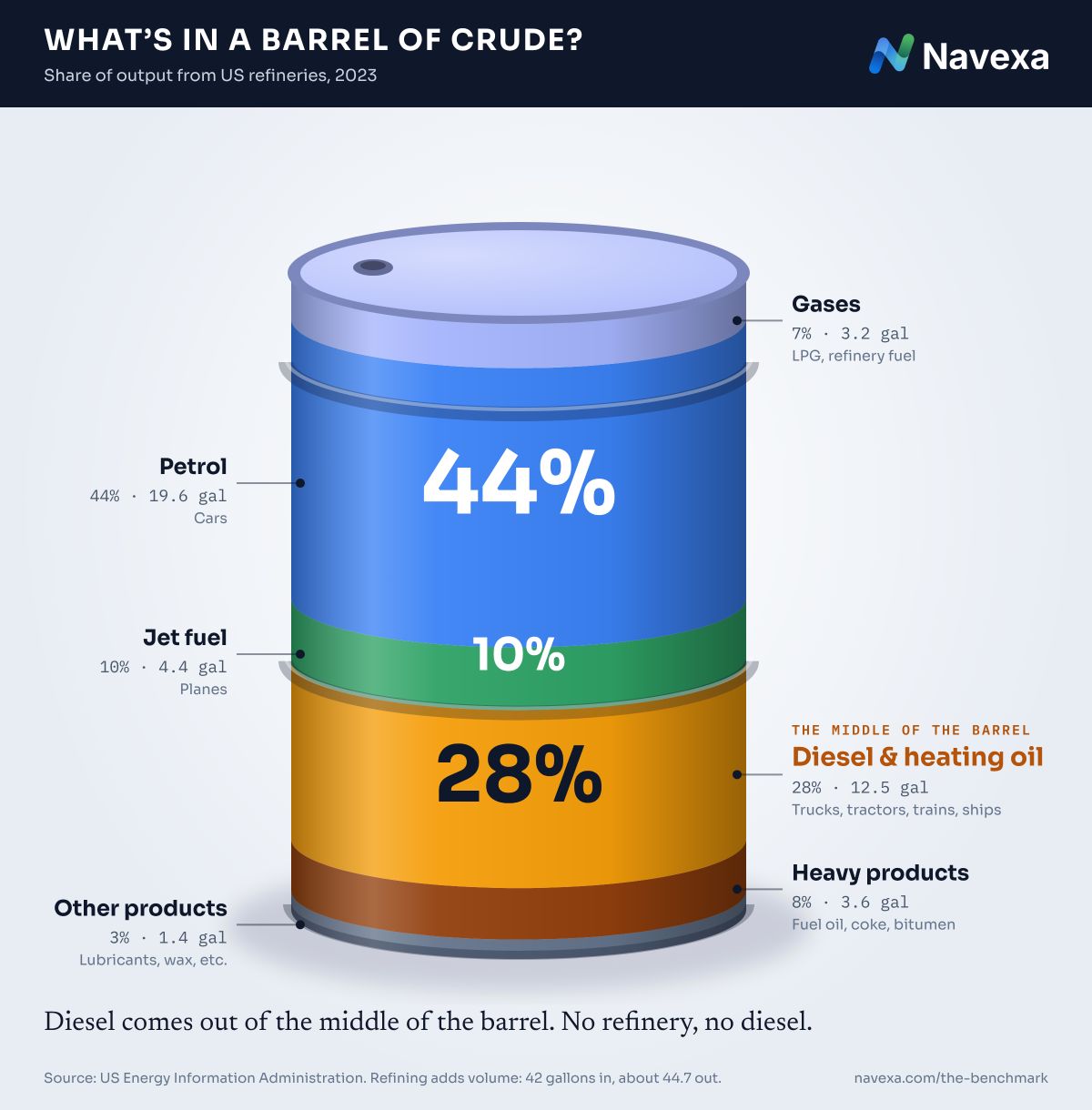
This year the world lost a lot of refining in a hurry.
Ukrainian drones have knocked out a huge share of Russia's refineries. By one S&P Global estimate, almost 60% of Russian capacity was offline in July. Moscow has now banned diesel exports.
The war with Iran has closed the Strait of Hormuz and knocked out Gulf refining and exports. Russell Hardy, CEO of Vitol, the world's largest independent oil trader, says the market is missing about 2 million barrels a day of products from Russia, and nearly as much from the Middle East.
Bombs are falling on refineries again.
And the West doesn’t have enough refining of its own to fall back on.
Why?
There are five reasons — each of which made perfect sense at the time.
Refineries are enormous, expensive and built to run for decades. They make money on the gap between crude and fuel. But for long stretches, that gap was thin.
The mid-2000s were a golden age for refiners. In 2005, Valero, then America's largest refiner, doubled its profit to a record $3.6 billion. By mid-2007 it was earning more than $18 on every barrel it processed.
Then the global financial crisis crushed fuel demand. By 2009, Valero's margin had fallen below $6 a barrel and the company lost almost $2 billion.
In northwest Europe, BP's refining margin halved in a single year.
Between 2008 and 2013, 16 European refineries closed, taking 1.7 million barrels a day of capacity with them, according to the International Energy Agency. France alone lost a quarter of its refining capacity between 2008 and 2012.

In 2012, the Coryton refinery near London, one of the most modern in Europe and the source of a tenth of the UK's fuel, shut down after its owner, Petroplus, went bankrupt.
When a plant can't cover its costs, closing it is the rational call.
While Europe's old plants struggled, new ones were going up elsewhere. They were bigger, newer, more sophisticated, and built to export.
Between 2000 and 2009, China grew its refining capacity by 75%, India by 61% and the Middle East by 22%. The capacity they added was equal to 44% of everything the EU had.
A small, ageing refinery in Europe or Australia couldn't compete. Buying diesel from a mega-refinery in Asia or the Gulf was simply cheaper than making it at home.
Australia shows where that logic ends up.
In 2005, Australia had eight refineries. Today it has two, Ampol's Lytton plant in Brisbane and Viva Energy's Geelong plant in Victoria. Together they cover only about a fifth of national demand. Most of the rest arrives by tanker from Singapore, South Korea and Malaysia.
The closed plants simply lacked the scale and sophistication of their Asian rivals.

Europe found an even more convenient supplier on its doorstep.
In the year to September 2022, Russia supplied 53% of Northwest Europe's seaborne diesel imports, according to the US Energy Information Administration.
It was cheap, close and seemingly endless. Then, on February 5, 2023, the EU's ban on Russian oil products took effect. That month, Russia's share fell to 2%.
Europe filled the gap largely with diesel from the Middle East, India and the US. By the eve of this year's war with Iran, the Middle East was supplying about 27% of Europe's diesel imports.
Then the Strait of Hormuz closed.
Europe had swapped one fragile supply line for another, while its own refineries kept closing.
Imagine you sit on a refinery board in 2020. Governments are promising to phase out petrol and diesel cars. Carbon costs are rising. Your plant needs a major reinvestment to keep running for another 20 years.
Do you sign the cheque?
California's refiners answered that question. The state has lost about 20% of its traditional refining capacity since 2020, with nearly another 20% lost to two more recent closures. Refiners pointed to weak margins and aggressive state legislation.
Phillips 66 stopped refining in Los Angeles in October 2025. Valero's Benicia refinery, near San Francisco, followed in April 2026.
Europe made the same call. In 2025, Shell stopped processing crude at Wesseling, near Cologne, BP cut capacity at Gelsenkirchen, and Grangemouth, Scotland's only refinery, closed.
Several of these sites are being turned into import terminals: places to receive fuel that someone else has made.
The 2020 pandemic emptied the roads and the skies. Fuel demand collapsed. The IEA counted about 1.7 million barrels a day of permanent refinery closures planned for 2020 and 2021, more than a million of them in the US.
US refining capacity fell 4.5% in a single year, from 19 million barrels a day at the start of 2020 to 18.1 million at the start of 2021.
The demand came back. But the refineries did not.
At the start of 2026, US capacity stood at 18.2 million barrels a day, barely above where the pandemic left it.
Every refinery closure was defensible at the time. None of it looked like a mistake on a balance sheet.
Spare refining capacity is exactly the kind of thing balance sheets punish. It looks like waste — right up until the day you need it.
That day has arrived.
The EIA expects US distillate inventories, the category that includes diesel, to stay below their five-year low through the end of 2026 and most of 2027.
Australia imports around 90% of its refined fuel. In March, it held only about 30 days of diesel. The International Energy Agency asks its members to hold 90 days of net imports. Australia effectively stopped meeting that obligation in 2012.
Between May 1944 and March 1945, it took 22 raids to stop production at the Leuna plant. The Eighth Air Force lost 1,280 airmen in the campaign.
Leuna is still there. TotalEnergies runs one of Europe's largest and most modern refineries on the site.
It makes diesel.
This week's quote:
'On no one quality, on no one process, on no one country, on no one route and on no one field must we be dependent. Safety and certainty in oil lie in variety and variety alone.'
— Winston Churchill
Invest in knowledge,
Thom
The Benchmark
Read more: A tale of two investors
Enjoyed? Forward this edition to a future subscriber (or subscribe yourself).
Connect: I post every day on LinkedIn
Get the next issue
The Benchmark lands free in your inbox every Thursday.
On a cold Monday morning in January 2000, two investors sat down at their kitchen tables. They each had $100,000 to invest.
On September 8, a 27-year-old British researcher sat on a park bench in San Francisco’s Alamo Square and announced on X that he’d quit his job.
In the spring of 1381, more than a third of England vanished. Compared with a count taken four years earlier, the number of taxable adults in the kingdom had…