
Follow the ladder:
The 500-year playbook for the AI oligopoly
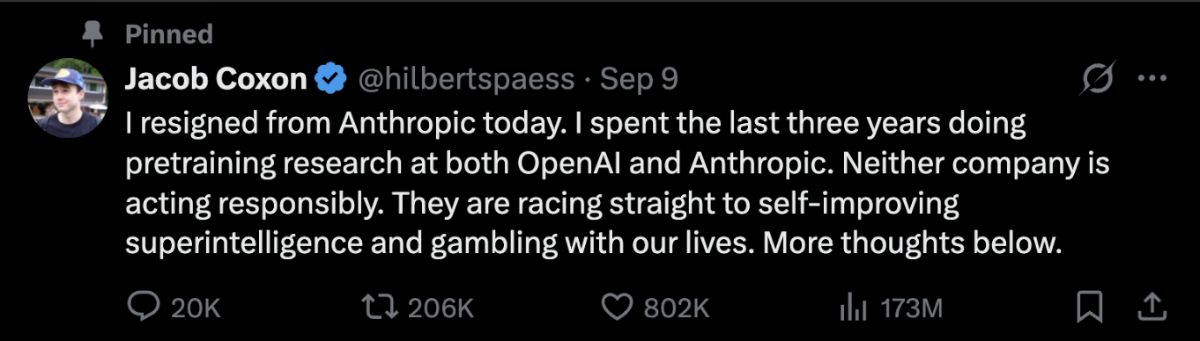
On September 8, a 27-year-old British researcher sat on a park bench in San Francisco’s Alamo Square and announced on X that he’d quit his job.
Jacob Coxon had spent three years building the core models at OpenAI and then Anthropic, two of the most valuable private companies on earth.
Neither company, he wrote, was acting responsibly. Both were racing toward self-improving superintelligence and gambling with our lives.
More than 170 million people have seen Coxon’s post.
Just four days later, Anthropic CEO Dario Amodei published an essay calling on the industry to slow the pace at which AI models get more capable.
His essay was titled We Must Pace the Frontier.
Amodei called for US regulation covering every frontier AI company, including any that won't sign up voluntarily.
He also asked the government for a narrow antitrust waiver, so rival labs could coordinate on safety without breaking competition law.
Within hours, OpenAI’s Sam Altman agreed.
Shortly after that, Elon Musk — who’s spent part of this year suing Altman — agreed, too.
Some thought it strange that three such highly competitive CEOs were suddenly so publicly aligned.
When fierce competitors all want the same rule, it’s worth asking who the rule is for.
Baptists, bootleggers & psyops
A second story swiftly followed Coxon’s.
Critics led, by Silicon Valley investor David Sacks, called his announcement and the subsequent calls to pace the AI frontier a psyop.
They said the post was amplified within minutes by advocacy groups funded by early Anthropic investors…
That the press coverage was lined up in advance…
And that the real target was a federal licensing regime the big AI companies’ smaller competition couldn’t survive.
Some of the pieces check out. Coxon did take a 2022 scholarship from the foundation of Dustin Moskovitz, an early Anthropic investor. Moskovitz’s philanthropy says it’s on track to commit more than $1 billion to AI policy this year.
But not all the psyop takes fit. Nobody has proven that anyone told Coxon what to post and when.
And whether he was an industry plant, or part of a psyop, might not even be as interesting as what the past suggests is really going on here.
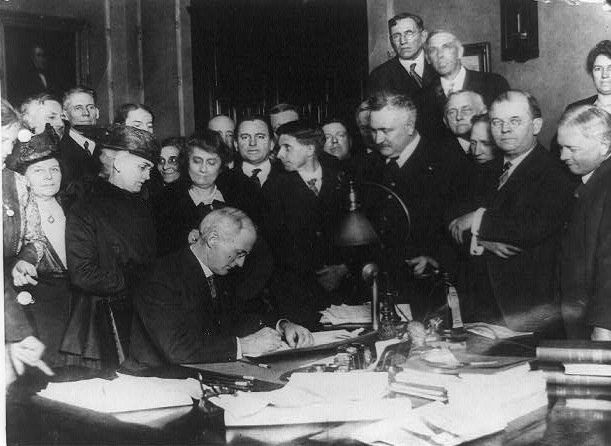
In 1983, the economist Bruce Yandle looked at the laws banning Sunday alcohol sales across the American South. Two groups backed them: Baptists wanted them on moral grounds, and bootleggers wanted them because they made their money on the days the legal bars were shut.
The two groups never needed to meet or conspire. One supplied the moral case, and the other quietly profited from it.
So why would the leading AI companies want regulation right now?
Subsidizing the frontier

The frontier AI labs have much reason for wanting to dig a moat around their businesses.
OpenAI is projecting a $14 billion loss this year, with no profit expected before 2029. The vast majority of ChatGPT’s 900 million weekly users pay nothing.
That is by design. By subsidizing usage now, the idea is you can build the habit and userbase, and then charge later. Uber did it with ridesharing. Amazon did it with shipping.
Anthropic is closer to paying its own way. It expects its first operating profit this year.
But neither company has yet closed a year in the black.
A big risk in the subsidize-now model is that a cheaper rival arrives before you can raise prices.
Many such rivals to the big American AI players already exist. Open-source models from Meta and Chinese labs are free to download and sit just a few months behind the frontier.
A price war against free is hard to win.
But a rule that makes free models expensive to build…
The playbook is older than electricity.
See if any of the following feels familiar.
The 140-year printing monopoly
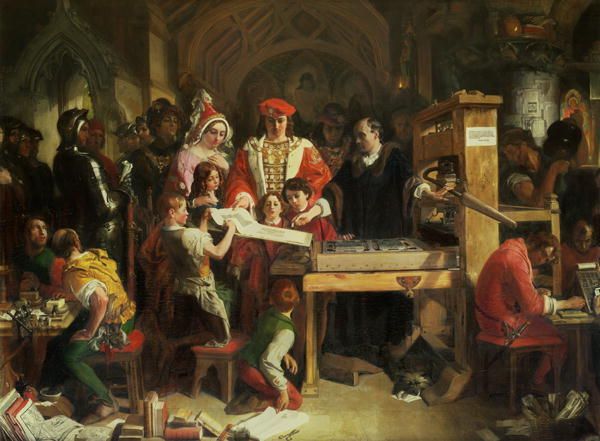
William Caxton set up England’s first printing press in 1476. To the Crown, a machine that could copy a pamphlet thousands of times was a threat. It spread heresy, sedition and eventually the Reformation.
So in 1557, Queen Mary I granted a royal charter to the Stationers’ Company, the guild of London printers and booksellers.
The Stationers got a near-monopoly over English printing. The Crown got a police force: the charter empowered the guild to search premises and seize unlicensed books.
The safety measure and the commercial moat were the same document.
The arrangement survived, in various forms, for most of the next 140 years. When controls collapsed during the English Civil War, the Stationers petitioned Parliament to bring licensing back.
Then in 1695, Parliament let press licensing lapse.
London got its first daily newspaper seven years later. Presses spread across the provinces. The technology outlasted the gatekeepers, and its impact finally reached everyday people.
The 70-year phone line monopoly
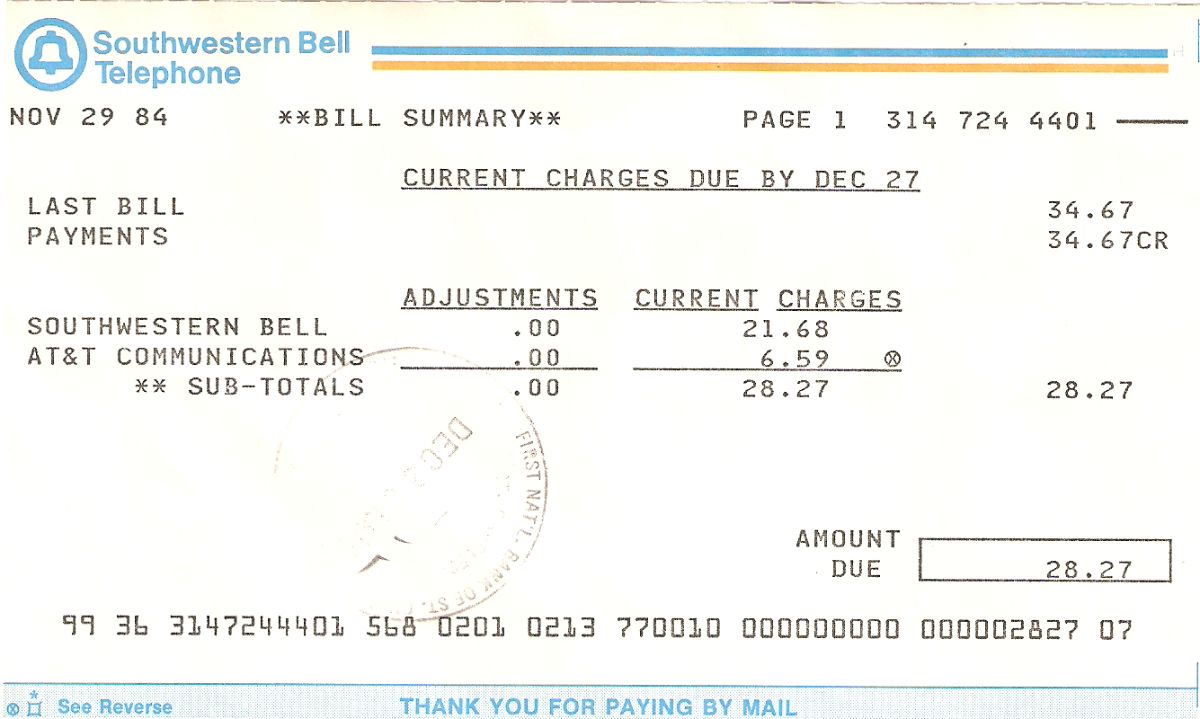
By 1907, AT&T had a problem. Alexander Graham Bell’s patents had expired in the 1890s, and thousands of independent telephone companies had flooded the market.
The new president, Theodore Vail, chose not to fight them on price. He argued the telephone was a natural monopoly and invited the government to regulate it. His slogan was ‘One Policy, One System, Universal Service’.
Washington took the deal. In 1913, under antitrust pressure, AT&T agreed to let rivals connect to its long-distance lines, and the government backed off. By 1934, a new federal regulator was overseeing the phone business as a utility, with AT&T at its centre.
For the next seventy years, AT&T was the American phone system.
It became a classic widows-and-orphans stock, the kind of safe, dividend-paying holding advisers recommended to people who couldn't afford to lose money. It was also going nowhere fast.
The breach came from outside the walls. Until 1968, Americans had to rent their telephones from AT&T. But that year, the regulator ruled that customers could plug in phones and devices made by anyone.
In 1984, after a decade-long government antitrust case, AT&T broke into seven regional companies.
The Marlboro monopoly

For decades, Big Tobacco fought regulation with everything it had. Then, in 2009, the market leader switched sides.
Philip Morris, maker of Marlboro and holder of about half the US cigarette market, backed the Family Smoking Prevention and Tobacco Control Act, which handed the FDA authority over tobacco. Rivals fought it.
Critics called it the Marlboro Monopoly Act.
New products now needed FDA approval. Marketing restrictions made it harder for smaller brands to win smokers away from the leader. Nobody seriously disputed the health case, and the biggest incumbent did very well out of it.
Then a challenger arrived from outside the category the law was written for.
Juul, a Silicon Valley vaping startup, launched in 2015. Within three years it held more than 70% of the US e-cigarette market.
The rules Philip Morris had backed couldn't touch it. So in 2018, the Marlboro maker paid $12.8 billion for a 35% stake in the upstart it couldn’t keep out.
Pulling up the ladder behind them
History suggests where this sudden ‘please regulate us’ chorus might be coming from.
When incumbents help write the rules, it usually works, for a while. The Stationers held their grip for the better part of 140 years, AT&T 70, and Philip Morris locked in an unfair advantage for years.
More recently, one of Amazon’s great advantages over bricks-and-mortar retail was that most of its customers paid no sales tax. But in 2011, Amazon backed a federal bill letting states tax online sales.
It gave up its edge on purpose. Amazon could afford the software to calculate and collect tax across thousands of jurisdictions. But its smaller rivals could not. A rulebook only the biggest player can afford to follow works about as well as a monopoly.
Protection also changes what shareholders own. A company shielded from competition can stop growing fast and start collecting steady profits instead, like a landlord collecting rent rather than building new houses.
Anthropic has reportedly pushed its IPO to November, still seeking a valuation near $2 trillion. OpenAI has deferred its listing to 2027. Altman called this an ill-advised moment to go public, citing safety risks, in the same week he backed slowing the industry down.
For now, the loudest voices for slowing AI are also the ones dictating the moment the public finally gets to see their books. We don't know for sure yet just what the AI labs’ finances look like.
In the past, monopolistic companies feared provincial printing presses, competitors’ phone handsets, and vapes. Today they’re afraid of open-source AI models and labs beyond American jurisdiction.
They also fear the courts. On September 18, four consumers sued Anthropic, OpenAI, Google and Musk’s merged SpaceX and xAI, alleging the pacing push is an illegal agreement to slow competition.
This story differs from the others in one way. The stakes this time are — according to those wanting the government to pace the frontier — existential.
Remember Coxon’s words: ‘gambling with our lives’.
If they’re correct, then some kind of moat might be the price of safety.
But the pattern seems clear: When an industry’s leaders call for rules and regulations, there tends to be something big in it for them.
Because once you’ve made it to the top, the only way to stop others taking your place is to pull up the ladder you’ve climbed.
This week's quote:
'The innovator has for enemies all those who have done well under the old conditions, and lukewarm defenders in those who may do well under the new.'
— Niccolò Machiavelli, The Prince
Invest in knowledge,
Thom
The Benchmark
Read more: The secret history of failed taxes
Enjoyed? Forward this edition to a future subscriber (or subscribe yourself).
Connect: I post every day on LinkedIn
Enjoyed this issue?
Subscribe to The Benchmark
Weekly insights on markets, investing, and portfolio strategy.