Getting started with Navexa: Week 1 webinar
Watch the Week 1 webinar, read or download the slides, and work through portfolio setup, imports, missing trades, dividends and the Soul Patts–Brickworks merger.
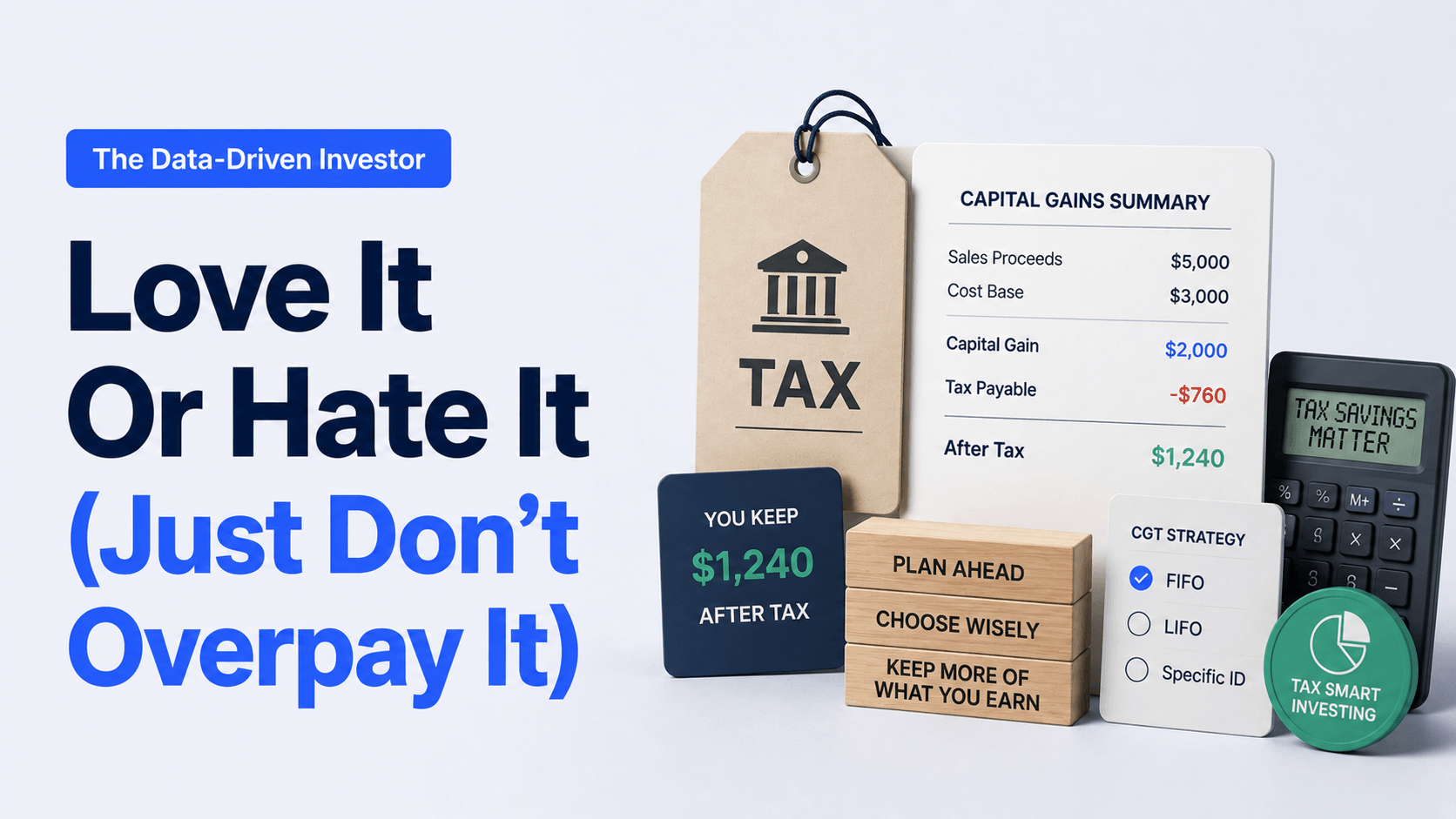
There is an element to investing that people try to ignore.
It’s not fun.
It’s not sexy.
And it involves you losing a chunk of your hard earned investment gains.
Of course, I’m talking about tax.
I’m yet to meet a person who loves this aspect of investing.
Except maybe my accountant.
Yet, this is an area that you can not ignore.
I personally have ended up paying the government much more than was legally required.
Why? Because I didn’t like thinking about tax.
I didn’t want to know.
I didn’t optimize my investments for tax outcomes.
And, I paid for my wilful ignorance.
If you’re investing, here’s what you must understand about taxation.
In many countries, you have to pay capital gains tax when selling a stock.
This is a portion of the profit you make from the sale.
This is calculated by using the cost base of the holding and subtracting the gain by the cost base.
E.g. You buy some shares for $1000 (cost base) and sell them for $1500, you have made a $500 gain.
But what happens when you have bought the same stock multiple times (parcels), then sell some of it?
You get to choose a CGT strategy for calculating the gain/loss.
This can have a significant effect on what the end gain works out to be.
Let’s look at an example:
So all up I own 300 shares of stock ABC.
What happens if I sell 100 shares for $5 a share for a total of $500?
I could use the FIFO (first in, first out) strategy — I sell the first shares I bought.
So that makes the cost base $300 and the sale $500 — a $200 gain.
I could use the LIFO (last in, first out) strategy — I sell the last shares I bought.
This makes a cost base of $600 and the sale of $500— a $-100 loss.
There are other strategies, too.
But you can see from this simple example how you can go from owing tax, to owning nothing.
And if all the CGT strategy options still result in a gain, there’s still moves you can make to mitigate.
When you pay capital gains tax, you pay it as a total of your entire portfolio.
Which means if you make a gain on one stock, you can cancel it out with a loss from another.
This is tax loss harvesting.
Tax loss harvesting is a strategy that involves selling stocks at a loss to offset a capital gains tax liability, thereby optimizing your after-tax returns.
This concept is powerful enough to potentially kill an investment tax obligation.
Even with just this basic investment tax knowledge, you can potentially save a lot of money.
There’s no excuse for not knowing how investment taxes work.
If I had known these tax basics when I started, I might have kept a lot more of my gains.
So before you do your next tax return, have a think about which CGT strategy you are using.
If you are an Australian tax resident and it starts getting hectic calculating cost bases and keeping track of parcels, remember we help with that.
Check out Navexa now.
As always, knowledge pays the best dividends.
Navarre
Track your portfolio in Navexa
Free 14-day trial. No credit card required.
Try Navexa Free →Watch the Week 1 webinar, read or download the slides, and work through portfolio setup, imports, missing trades, dividends and the Soul Patts–Brickworks merger.
Navexa now supports Indian shares on NSE and BSE. Find thousands of stocks, including Infosys, and track them alongside investments from other supported markets.
Why an RBA rate change reaches mortgages, spending and investments at different times, and why lower inflation can still leave life feeling expensive.
.png)