Who's Buying the Gold Nobody Can Trace?
On October 7, China's central bank published one of the dullest documents in finance: its monthly reserve statement.
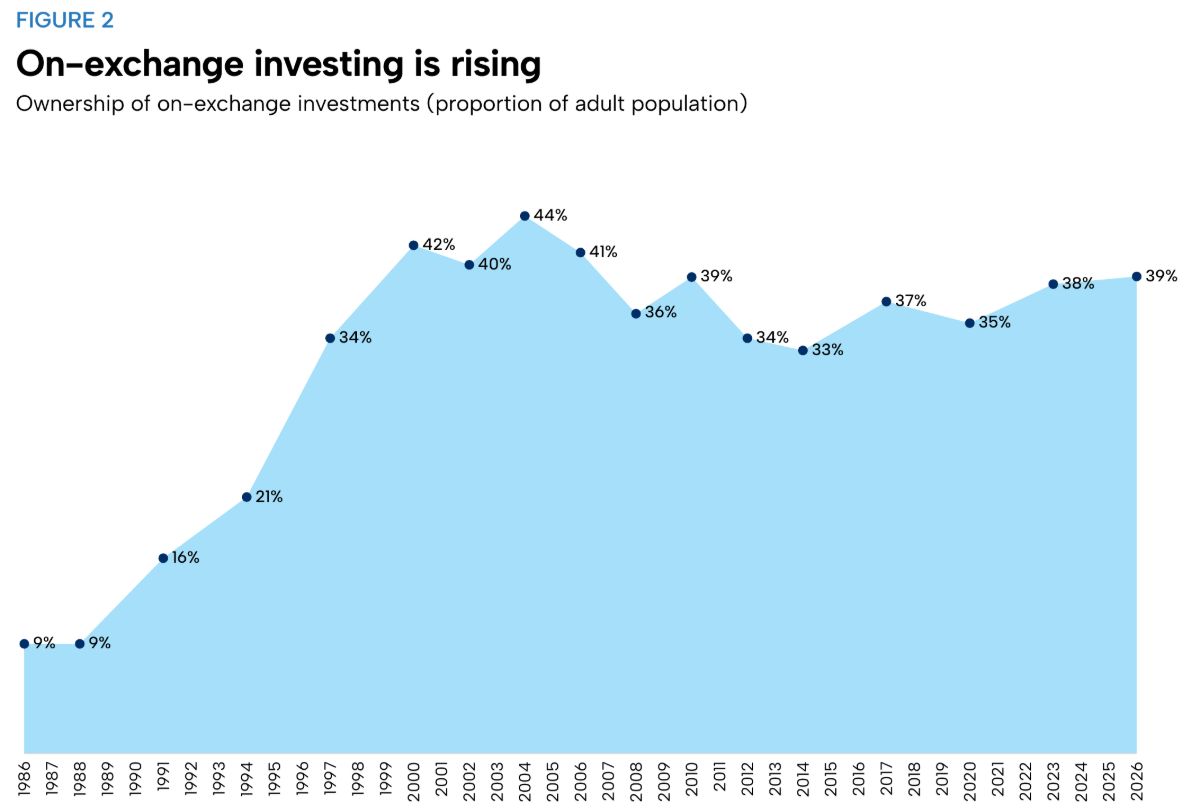
In 1986, Australia's stock exchanges ran the first edition of a survey called the Australian Share Ownership Study. It found that about a million Australians, just over 9% of adults, owned shares.
Shareowners then were mostly older, male and well-off. One in three was over 55, and more than a third were executives or professionals.
Many of them had bought in recently. The All Ordinaries index rose 133% between 1983 and 1986, and the survey's authors suggested that rally was the main reason share ownership had grown.
In 1987, the six state stock exchanges merged into one national exchange, the Australian Stock Exchange (ASX). In October that year, ASX launched SEATS (Stock Exchange Automated Trading System), its first computerised trading system, starting with a handful of companies. According to ASX, SEATS went live the day before the crash.
On Monday 19 October 1987, the Dow Jones Industrial Average fell 22.6%, Wall Street's worst day on record. It became known as Black Monday. Because of the time difference, the selling reached Australia on Tuesday 20 October. The All Ords fell 25% that day, which is still its largest one-day fall.
This month, ASX published the 2026 edition of the same survey, now called the ASX Australian Investor Study. It finds a record 11.5 million Australian investors, and most of them say they want to avoid risk.
Share of Australian adults holding exchange-listed investments, 1986 to 2026. Source: ASX Australian Investor Study 2026.
By the end of this Benchmark, you'll understand why those answers are less reliable than they look, and why a survey taken a year after the 1987 crash might be a better guide to how Australian investors behave when markets fall.
ASX ran the survey again in 1988. Because the crash had just happened, it could ask shareowners what they had actually done, rather than what they would do.
17% said they had sold some or all of their shares after the crash. The other 83% had not sold.
The number of Australians owning shares also rose slightly between 1986 and 1988, despite the crash.
That makes 1988 the study's best record of how Australian investors behave after a real crash: about one in six sold.
New Zealand shows how differently the same crash could play out.
By mid-1987, more than 40% of New Zealand adults owned shares, according to New Zealand Geographic. The country's market had risen about 600% in five years, and some investors had taken out second and even third mortgages to buy more.
New Zealand's market fell 15% on Black Tuesday, less than Australia's 25%. But it kept falling. Four months later it was down almost 60% from its peak, and by 1988 the country was in recession.
It was the same crash in the same week. But the market that had risen higher, partly on borrowed money, suffered far deeper losses.
For the 2026 study, research firm Investment Trends surveyed 4,495 Australian adults in January and February.
It found that 11.5 million Australians, or 54% of adults, hold investments outside their super and family home. That's 2.5 million more than in 2020. The study now counts all investments, not only shares, so the figure isn't directly comparable with 1986's million shareowners.
On risk, the answers are consistently cautious:
ASX notes that its findings don't support the common view that young investors chase risk.
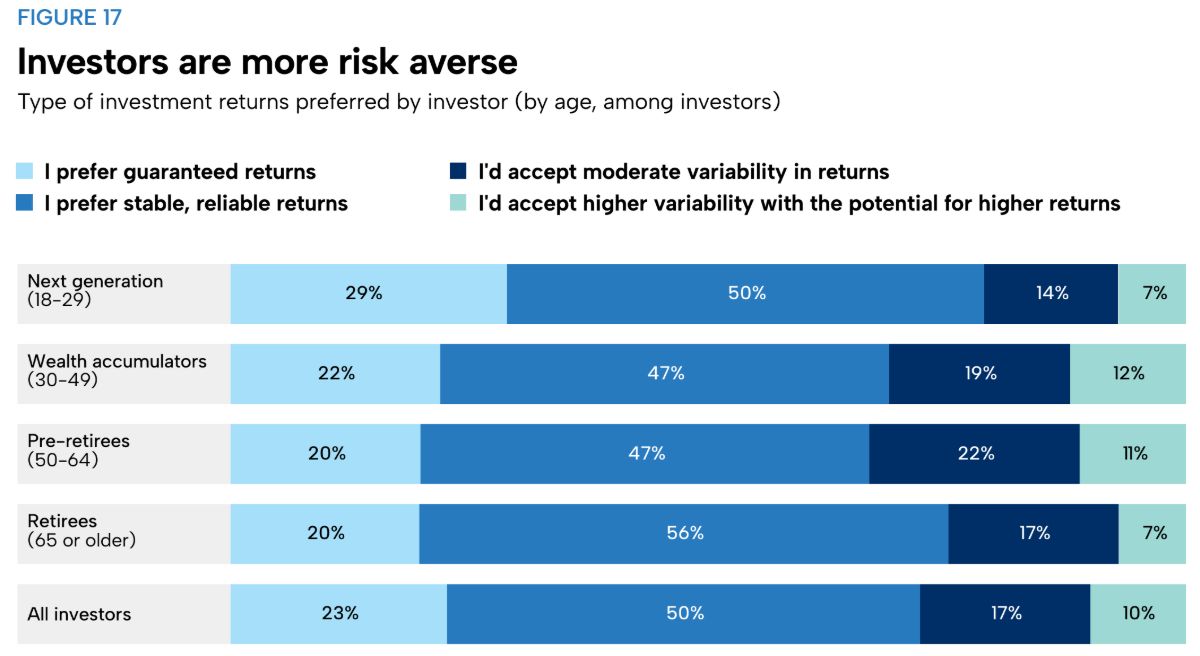
Type of returns investors prefer, by age. Source: ASX Australian Investor Study 2026.
Investors' holdings are less cautious than their answers.
24% of investors, or 2.79 million Australians, hold or have recently traded cryptocurrency, up from 15% in 2023. That's the same share as hold ETFs. Among investors aged 18 to 29, 15% made crypto their first-ever investment.
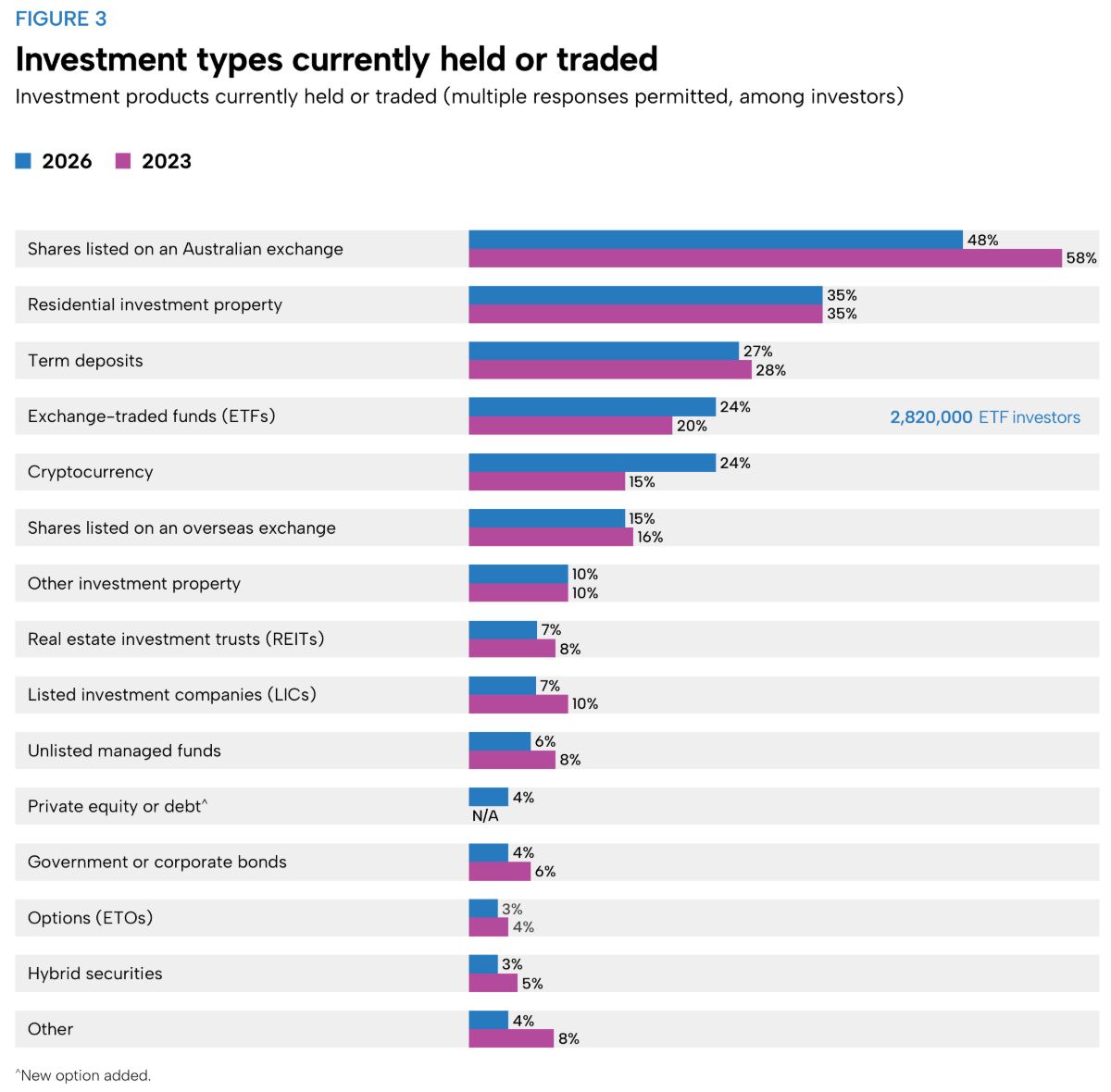
What Australian investors hold, 2023 vs 2026. Source: ASX Australian Investor Study 2026.
Crypto is one of the most volatile assets an investor can own. If most investors say they want stable returns, and a quarter of them own crypto, then the survey's answers about risk don't fully describe what is in their portfolios.
The study has recorded a high point before. In 2004, 55% of Australian adults, about 8 million people, owned shares directly or through managed funds. ASX counted differently then, so this isn't directly comparable with 2026's 54%.
Many of those owners had received shares without deciding to invest. In the 1990s, governments privatised companies such as the Commonwealth Bank and Telstra, and member-owned institutions such as AMP and the NRMA listed on the exchange. AMP had 1.4 million shareholders when it listed in 1998, many of them policyholders who were given shares.
Investors in 2004 were optimistic. In ASX's focus groups that year, they said shares had “come good” and that property had had its day.
By 2006, before the GFC began, ownership had fallen to 46%. ASX found that most of those who left were inactive investors who had received shares through floats and demutualisations, and many sold to pay for mortgages and property.
Those who stayed were still optimistic. In 2006, 58% planned to increase the share of their money in the market over the following year. Then came the GFC.
Even then, investors' answers stayed upbeat. In the 2008 study, eight in 10 direct shareowners told ASX it was a good time to buy or hold shares.
Two years later, their answers had changed. The 2010 study identified a large group it called “Prudent Investors”: experienced investors rebuilding portfolios the GFC had damaged. In the study's words, ‘While many may not be naturally conservative, they feel their current approach needs to be’.
By 2012, ownership was down to 38%.
Investors' attitude to risk changed after the losses, of course, not before them.
Today's investors differ from 2004's in one important way. Most chose to invest, through brokers, apps, ETFs and crypto exchanges, rather than receiving shares from a privatisation. That may make them more likely to hold on through a fall.
But the 2026 risk figures are answers to hypothetical questions. Many of these investors have already been through falls, including the COVID crash in 2020 and the crypto crash of 2022. What nobody can check yet is whether the 11% who say they'd sell after a 20% fall actually would.
The 1988 survey is the best comparison we have with real behaviour. After a 25% fall in one day, 17% of shareowners sold. In 2026, 11% say they would sell after a 20% fall.
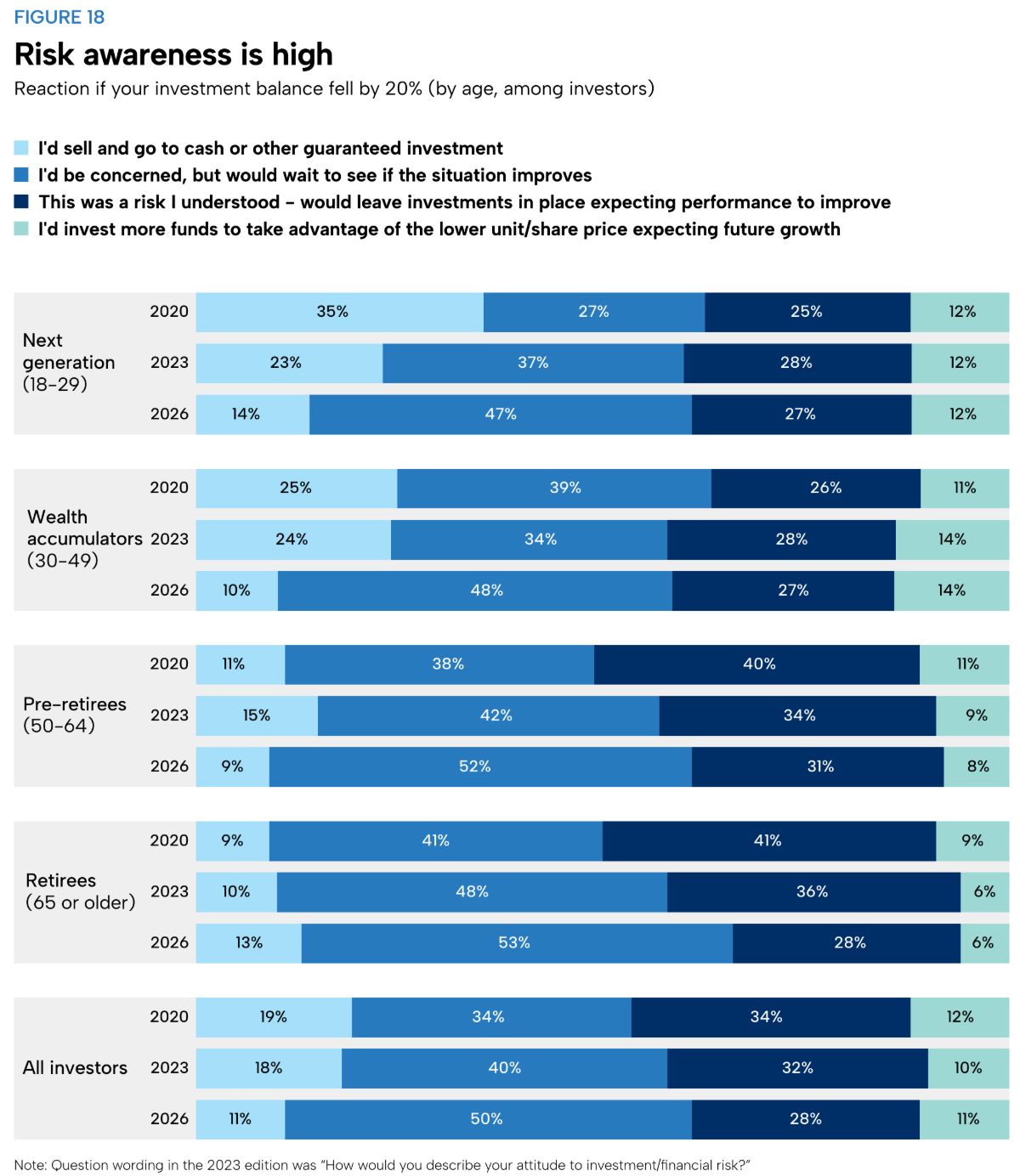
What investors say they would do if their portfolio fell 20%, by age. Source: ASX Australian Investor Study 2026.
The two numbers aren't directly comparable. One measures what people did after a larger, sudden crash. The other measures what people predict they would do. The gap doesn't forecast anything. It shows that the 2026 study records what investors expect to do, not what they've done.
Investors tell surveys how they'd handle a crash. But only a crash shows what they'll actually do.
This week's quote:
'Everybody has plans until they get hit for the first time.'
— Mike Tyson
Invest in knowledge,
Thom
The Benchmark
Read more: Who's Buying the Gold Nobody Can Trace?
Enjoyed? Forward this edition to a future subscriber (or subscribe yourself).
Connect: I post every day on LinkedIn
Get the next issue
The Benchmark lands free in your inbox every Thursday.
On October 7, China's central bank published one of the dullest documents in finance: its monthly reserve statement.
The ticket inspector flashed his identification. I opened the app containing my valid ticket, only to find that my valid ticket had not transferred over to my…
On May 12, 1944, the US Eighth Air Force flew bombers into central Germany with an unusual target list.