Meet Roi: The surprise we had in store for Owen Rask
Tom Wilson shares the story behind Navexa’s Roi reveal with Owen Rask. Watch the workshop replay, explore Scenarios and catch the audience’s questions.
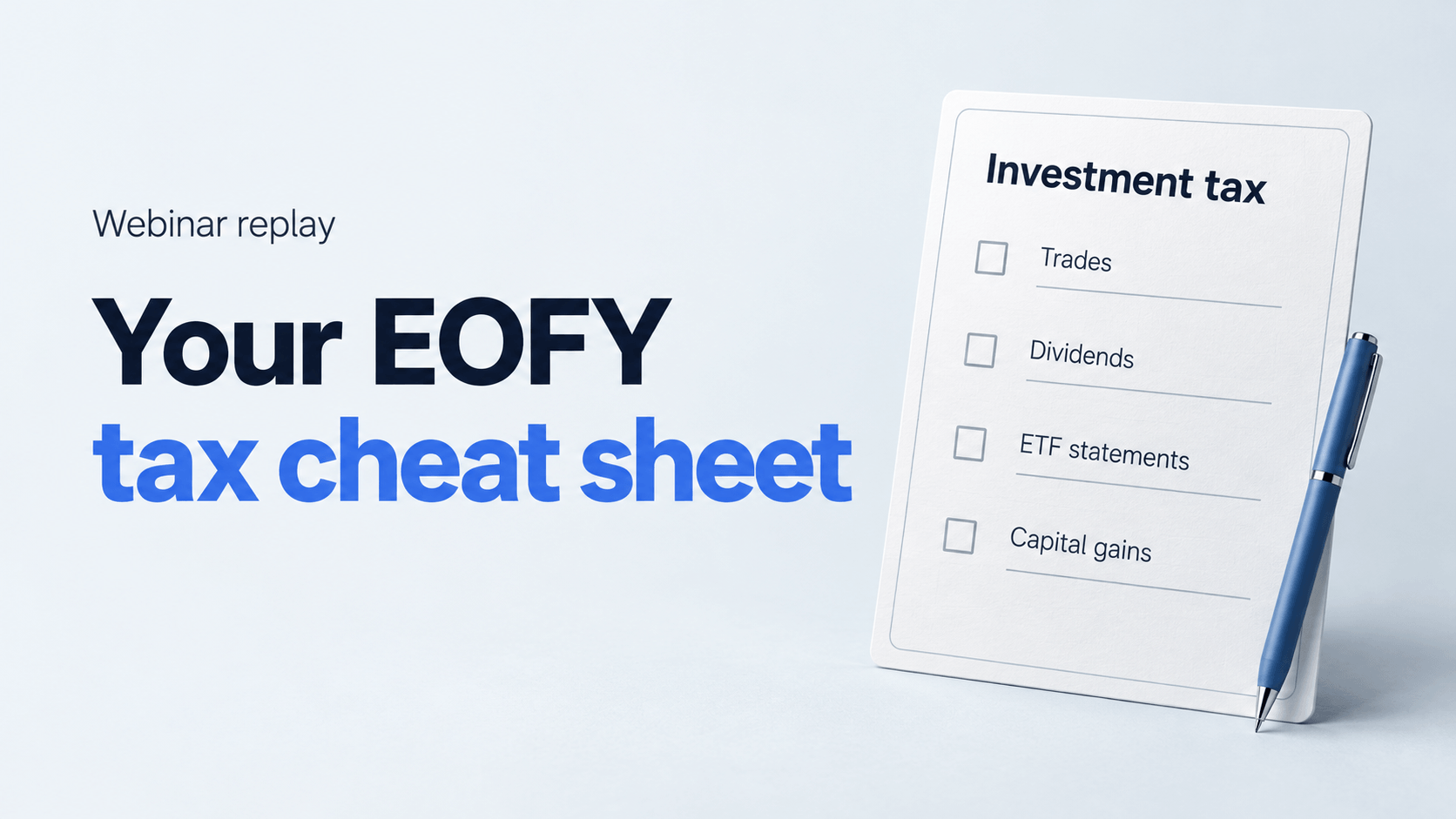
The cash arriving in your bank account is easy enough to find. Working out how that payment fits into an ETF's tax records takes a little more digging.
That was one of the main points I wanted to get across in my tax webinar with Marcus Today. We looked at investment income, annual fund statements, cost base adjustments and the purchase parcels sitting behind a capital gains calculation. Then Tom and I worked through questions from the audience.
The recording and presentation are below, followed by the examples worth revisiting and an edited selection of audience questions.
Recorded with Marcus Today on 19 October 2026.
The full recording
Investment tax records, AMMA statements and your questions answered.
Open on YouTube ↗Presentation PDF · 30 pages
The original 30-page webinar presentation. Read it alongside the explanations and tax note below. Open the PDF to save a copy.
When a dividend or distribution arrives, it's tempting to start and finish with the amount paid. For a fund using the AMIT framework, the annual statement contains more information than that bank entry can show.
AMIT means attribution managed investment trust. Its AMMA statement—the AMIT member annual statement—sets out the tax components attributed to you and any AMIT cost base net amount. Those components can include Australian income, franking credits, foreign income and capital gains.
Some information may appear in ATO pre-fill. That doesn't establish that every record is complete, or that your historical cost bases have been updated. Check the final statement against your records and the information being used for your return.
Our AMIT and AMMA guide explains the statements and where they fit in Navexa.
Here's the simple example I used in the webinar. A hypothetical investor buys 500 units at $20 each, giving an initial cost base of $10,000. The relevant AMMA statement specifies a cost base decrease of 15 cents per unit for those units.
Illustrative example · 500 units
AMIT decrease: $75.
If all 500 units are later sold for $12,500, the illustrated capital gain is $2,575.
Assumes this adjustment applies to all 500 units. Ignores brokerage and other adjustments. The figure is before capital losses, any eligible discount and personal tax.
The sale proceeds haven't changed. The historical number used in the calculation has.
Now add monthly purchases, reinvested distributions and several years of statements. Each acquisition has its own history. That is the administrative problem I wanted the example to make visible.
It doesn't mean copying one annual adjustment onto every parcel. Apply the statement's figures to the relevant units, following the issuer's information. Purchases and disposals during the year can matter. If a downward adjustment exceeds a unit's cost base, the excess can itself produce a capital gain. The ATO's AMIT guidance explains that distinction.
A holding is the investment as a whole. A parcel is a particular acquisition within that holding, with its own date, quantity and cost base. Reinvestments can add parcels too.
In the webinar's two-parcel example, 100 units were acquired at $10 each and another 100 at $15. A later sale of 100 units at $20 brings in $2,000. Matching that sale to the first parcel gives a $1,000 gain before other adjustments. Matching it to the second gives a $500 gain.
Those figures illustrate different recorded cost bases. They don't tell you which parcel to use or what your tax bill will be. Eligibility, previous disposals, capital losses and your entity's treatment still matter.
The detail that tends to disappear in a spreadsheet is what happens next. Once units from a parcel have been allocated to a disposal, those same units aren't available for another disposal. A purchase confirmation on its own doesn't show how many units remain after years of sales and reinvestments.
These questions get to the practical side of the records. The answers have been edited for clarity, with current product guidance linked where useful.
Audience question 01
The cash arriving in your bank account and the amounts attributed to you for tax can differ. For an investment using the AMIT framework, the annual AMMA statement sets out the tax components and any cost base adjustment.
That adjustment changes the records used in your capital gains calculation. It doesn't change the cash payment you've already received. Check the final statement for the investment you actually hold; not every ETF or fund uses AMIT.
Audience question 02
Yes. Reinvesting a dividend to acquire more shares or units creates another acquisition, with its own date, quantity and cost base. The reinvestment doesn't remove the underlying income from your tax records.
There are two records to account for: the income and the new parcel. Keep the reinvestment statement alongside your other source records.
Audience question 03
Navexa's manual parcel selection lets you match a recorded sale to specific purchase parcels with units remaining. You aren't limited to matching the oldest or newest parcel in the software. Manual selection is available on our Premium and Pro AUD plans.
The setting controls a calculation from your records. Your parcel identification needs to be supportable, and the tax treatment is something to review with your accountant or registered tax agent.
We also covered the legislated CGT reforms starting on 1 July 2027, the beginning of the 2027–28 financial year.
For covered investors, the calculation distinguishes gains accrued before that date from later gains. The new arrangements replace the 50% discount with cost base indexation for eligible individuals and trusts. Indexation generally requires at least 12 months' ownership, and a 30% minimum tax can apply to covered gains, subject to exceptions.
The transition includes a deemed sale and reacquisition for covered assets, with the pre-change gain or loss generally deferred until a later realisation event. It isn't simply an immediate tax bill because the calendar reaches 30 June. The rules don't apply uniformly to individuals, companies and SMSFs.
I won't turn the webinar's simplified example into a formula for your return here. The legislation contains the conditions and exceptions. A registered tax agent can explain how they apply to your circumstances.
The records point is straightforward: the earlier purchases, distributions, adjustments and disposals still matter. A change in the calculation doesn't remove the history behind it.
Navexa helps bring investment records and reporting data together. The usefulness of a report still depends on the history recorded in the account.
A practical records pack for your accountant or registered tax agent can include:
If you're entering an annual fund statement in Navexa, our statement-entry guide covers the process and the checks to make.
What I wanted to demonstrate in this session was why the history matters even when this year's task looks straightforward. A number that seems minor today can be the number needed to explain a calculation years later.
More from the webinar, including imports, separate entities and using Navexa on your phone.
Select a question to read the answer.
The record-keeping principles overlap, but the tax treatment differs. Under the discount rules applying before the 2027 change, eligible individuals and trusts may qualify for a 50% CGT discount. Eligible complying super funds may qualify for a 33.33% discount. Companies cannot use the CGT discount. The holding-period requirement is generally at least 12 months, and other eligibility rules matter.
The legislated 2027 changes also have their own scope and conditions. Keep the correct entity attached to your records and ask a registered tax agent about its treatment.
Yes. Keep each tax entity in its own portfolio. Our Australian Standard plan includes up to three portfolios, and Premium includes up to ten. Each portfolio has its own performance and tax reports. The current pricing page sets out the included portfolios and options for adding more.
Yes. You can import an All Trades Report spreadsheet from Sharesight. We also have a direct connection in beta, which needs some setup through Sharesight. Check the migrated transactions against your original records, and review income, reinvestments, corporate actions and annual fund statements separately. The spreadsheet route is a one-off trade-history import.
Yes. Our IBKR connection syncs supported trades, positions and balances daily. Individual accounts and multiple sub-accounts are supported. Older history outside the available backfill can be imported by CSV. The integration guide covers setup, supported activity and exclusions.
Use CMC Invest's Confirmations CSV to bring in your historical share and ETF trades. For new trades, you can set up trade confirmations to go to the relevant portfolio's Navexa Link email address. Our CMC guide covers the history import and the ongoing confirmation setup.
Yes. We have iOS and Android apps that use the same account and investment data as the web platform. You can view portfolios, manage trades and transactions, and access reports from your phone. Some tasks, including spreadsheet imports, are completed on the website; the imported data then appears in the app.
Yes, where the investment's market and security are supported. Navexa tracks shares and ETFs across Australian and many overseas exchanges. The broker's location alone doesn't determine coverage. Check our supported-markets guide for the exchange and security you hold; unsupported investments can be tracked manually as Custom Investments.
General information only. This article and its examples do not provide financial, investment or tax advice or take account of your circumstances. Navexa provides portfolio tracking and reporting tools based on the data recorded in your account. Review your records and speak with a registered tax agent about your tax treatment.
Track your portfolio in Navexa
Free 14-day trial. No credit card required.
Try Navexa Free →Tom Wilson shares the story behind Navexa’s Roi reveal with Owen Rask. Watch the workshop replay, explore Scenarios and catch the audience’s questions.
Navarre Trousselot shares how a personal investing question became Navexa, the lessons from its first paid launch, and why he still enjoys building it.
Join Navarre Trousselot and Owen Rask for a free live workshop on 16 October. Explore new ways to ask questions of your portfolio and compare possibilities.