
Prague: Robbed By Nazis, Communists, and Bureaucrats
I'm in Prague this week for BTC Prague, Europe's biggest Bitcoin conference.
Before heading to the event though, I’ve made a stop here (credit to Navexa founder, Navarre, for the photo):
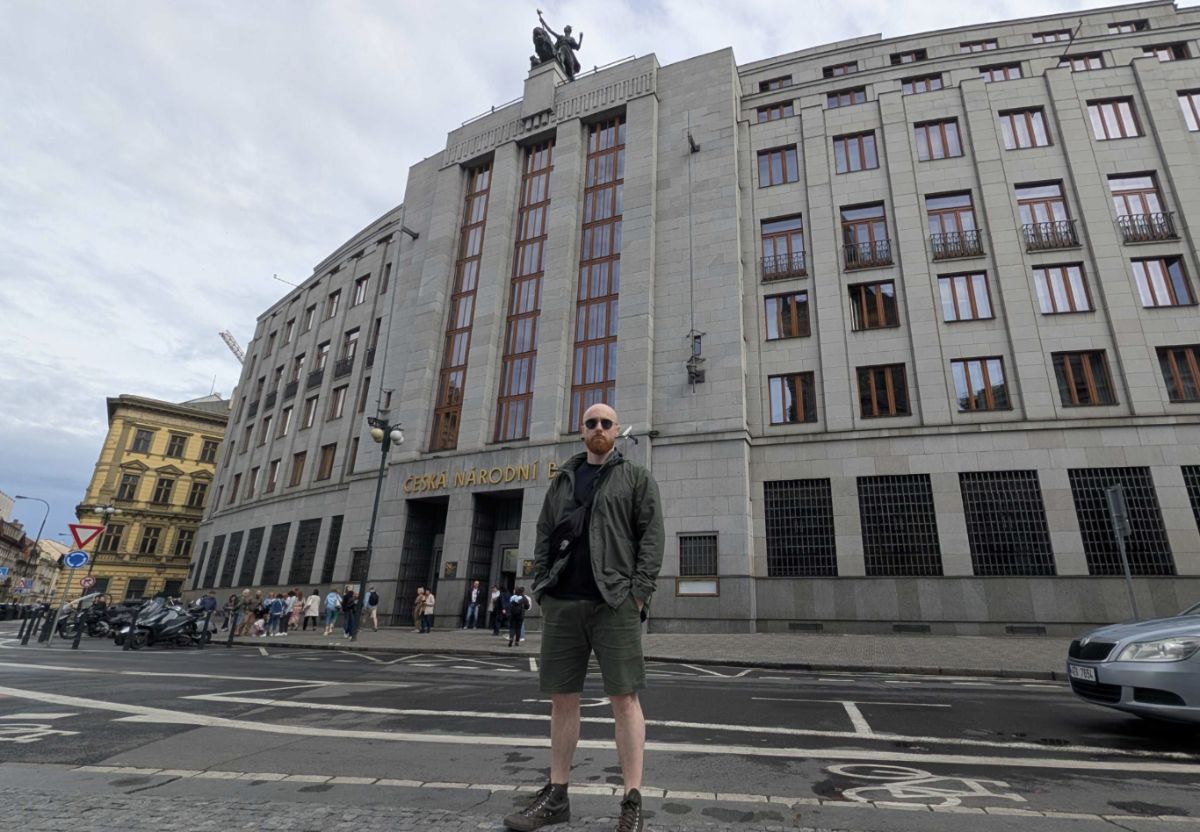
This is the Česká Národní Banka — the Czech National Bank.
And today, in the spirit of my attending a conference centred on sound money and financial sovereignty, I’m going to tell you about three times this bank has been robbed.
Robbery #1: The Nazis
In 1939, this institution was known as the National Bank of Czechoslovakia.
On March 15 that year, German troops marched into Prague through snow and rain.
This photo was taken around the corner from the hotel in which I am writing to you:

Within days, Germany’s Reichsbank had its eyes on the National Bank's gold reserves.
The gold was worth about $1.1 billion in today's money.
But the physical gold wasn't in Prague. It was held, as was standard practice, at the Bank for International Settlements (BIS) in Basel — the so-called central banker's bank — and at the Bank of England in London.
So the Reichsbank made a request: Transfer the Czech gold from the National Bank's account to theirs.
The Bank of England complied.
This happened despite the British government having frozen all Czech assets held in the UK following the invasion.
The governor of the Bank of England, Montagu Norman, was subsequently asked by the Chancellor whether the bank was still holding Czech gold. His reply carefully avoided answering the question.
The gold moved anyway. About £4 million went to banks in Belgium and Holland. The rest was sold in London.
Labour MP George Strauss stood up in the House of Commons and called the BIS "the bank which sanctions the most notorious outrage of this generation".
The institution that was supposed to be neutral — above politics, the bedrock of international financial trust — had looked at the ledger, and chosen the side with power.
When sovereignty collapsed, the assets went with it.
The gold didn't disappear because the vault was broken into, but because the people controlling the ledger made a decision.
And that was just the state's wealth.
For citizens, the theft was quieter: the Czech koruna was pegged to the Reichsmark at a rate that overvalued the mark by some 60%, meaning every German in the Protectorate bought Czech goods, assets, and labour at a discount — paid for by everyone holding koruna.
Robbery #2: The Communists

Fourteen years after the Germans marched on the city, Prague was under different management.
The Communist regime had been in power for five years.
The economy was struggling. Behind closed doors, party officials had been quietly preparing a monetary reform — a currency redenomination that would, in effect, wipe out private savings accumulated under the previous system.
On the evening of May 29, 1953, Czechoslovakia's president, Antonín Zápotocký, went on national radio.
He told the public the currency was strong. That there would be no monetary reform. That their savings were safe.
That same evening, the shops closed.
The next day, a different voice came over the same radio — Prime Minister Viliam Široký, announcing the reform Zápotocký had denied hours earlier. The president hadn't even delivered the betrayal himself.
The reform took effect on June 1.
Old currency could be exchanged for new — but at a rate of 50 to 1 for amounts above a basic threshold. Savings accumulated over a lifetime were reduced to almost nothing overnight.
The old and new currencies were both the Czechoslovak koruna (Kčs) — same name, new notes.
The new 1953 banknotes were printed in Moscow. So the money that replaced people's savings wasn't even printed in Czechoslovakia.
Here’s the before/after:

In the West Bohemian city of Plzeň, 20,000 workers poured into the streets. Most of them were employees of the Škoda factory. They had just received their monthly salaries in currency that was suddenly nearly worthless.
It was the first major public protest in any Soviet satellite state since the Communist takeover.
The man with the keys to the ledger had lied, on purpose, the night before he changed it.
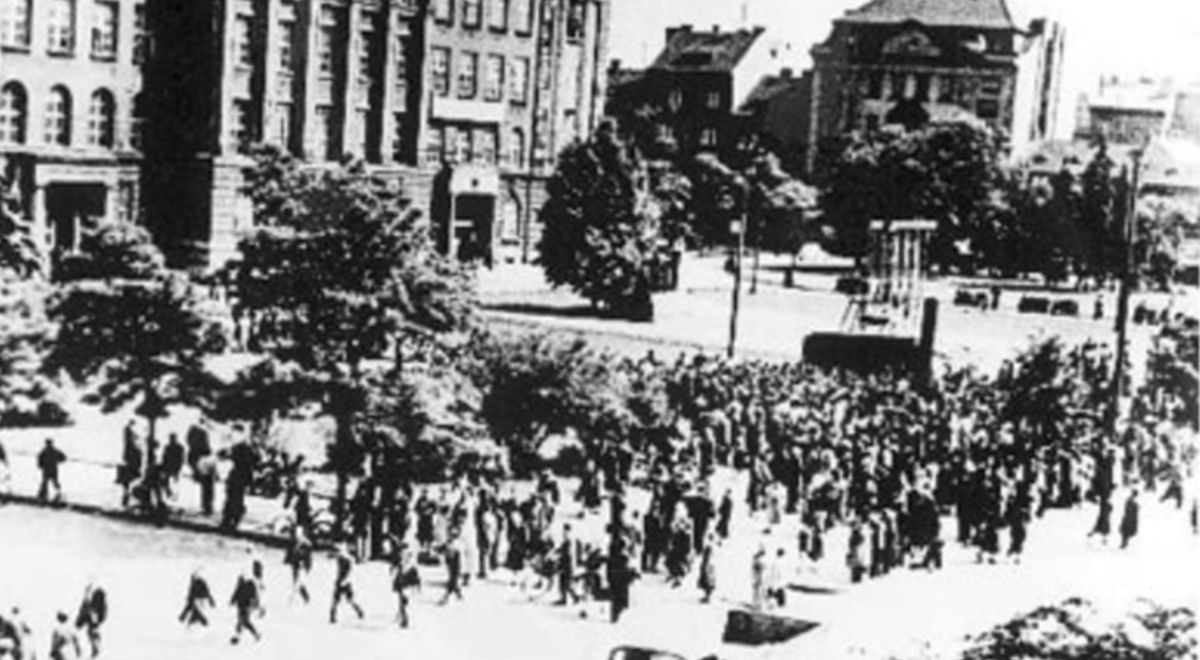
The protests were crushed. Hundreds were arrested, and in Plzeň, the military moved against the same workers the regime claimed to represent.
But the deeper damage wasn't measured in arrests. An entire generation learned, in a single morning, that savings were not theirs to keep — that prudence could be undone by decree.
For the next four decades, Czechs hid wealth in goods, in property, in anything the state couldn't reprint.
People’s trust in money, once broken, didn't return with the regime's fall. It simply moved elsewhere.
Robbery #3: The Bureaucrats
The third robbery is the quietest. And in some ways the most instructive.
On January 1, 1993, Czechoslovakia ceased to exist. The Czech Republic and Slovakia became independent states — the Velvet Divorce, named for the Velvet Revolution that had ended Communist rule just four years earlier.
The two governments signed a currency union agreement. The Czechoslovak koruna would remain the shared currency of both new states for at least six months while each side prepared for an orderly transition.
At least that was the promise. It lasted five weeks.
The problem wasn't bad faith. The problem was that everyone could do the maths.
The Czech economy was stronger, which meant a future Slovak currency would almost certainly be weaker — and if you were holding koruna in a Slovak bank, the rational move was to shift it into a Czech one while the two currencies were still the same thing.

So that's what people did. Deposits flowed west. Companies delayed payments to Slovak partners and accelerated payments to Czech ones. The expectation of separation drained the union, which forced the separation. The promise was being arbitraged to death by ordinary depositors doing simple arithmetic.
On February 8, the union was dissolved. Payments between the two countries stopped. Border controls were tightened to stop people moving cash. Citizens were given four days to present their banknotes for stamping. Stamped notes were valid in your new country. Unstamped notes were not.
Four days.
Nobody lost their savings in 1993. There was no villain, no lie, no jackboot — economists still cite it as the model currency separation.
But Slovaks who went to bed in January holding the same koruna as their Czech neighbours woke up in February holding something else. Within months, the new Slovak currency had devalued by around 10%.
No one was robbed. Their money was simply redefined — by a border they didn't draw, on a deadline they didn't set.
What will Prague teach us about Bitcoin in 2026?
Three times in 54 years, someone rewrote the rules of money in this city.
Each time, the people holding the ledger made a choice that ordinary savers couldn't see coming, and couldn't stop.
The threat wasn't always a foreign army. Sometimes it was a friendly voice on the radio the night before. Sometimes it was a bureaucratic deadline most people didn't hear about in time.
The specific failure mode, across all three episodes, is the same: the ledger was controlled by people whose interests, when it came to it, were not the same as the public’s.
It didn't matter how solid the building looked. It didn't matter how trusted the institution was. It didn't matter that the gold was supposed to be ring-fenced, frozen, protected by diplomatic convention.
When the moment came, whoever held the account details held the power.
Sovereignty over your assets was always, ultimately, borrowed from the state.
Even today, you can dig into the fine print of many banks’ terms and conditions only to discover that ‘your’ money in the bank is really theirs.
Bitcoin — the asset we're in Prague this week to discuss — is the first monetary system in history where this particular failure mode doesn't exist.

Not because the people involved are more trustworthy. They aren't. The industry around Bitcoin is full of humans making promises, and humans break promises when their incentives change — as the last decade of exchange collapses and abandoned pledges has demonstrated repeatedly.
The difference is narrower than the evangelists claim, and more important than the sceptics admit: the protocol itself makes no promises that depend on anyone keeping them. The supply is fixed by mathematics, not policy. The ledger is held by everyone, which means it can be captured by no one. There is no governor to lean on, no president to lie on the radio, no account at the BIS to quietly reassign.
Everything built on top of Bitcoin can fail the old-fashioned way. But the base layer cannot.
Whether that distinction matters is, in the end, a question about history. And Prague has rather a lot of it.
A city that has watched its ledger captured by force, rewritten by lies, and dissolved by arithmetic might reasonably conclude that a ledger no one controls is worth at least a conversation.
Which is perhaps why, this week, tens of thousands of people are here to talk about it.
This week's quote:
"The struggle of man against power is the struggle of memory against forgetting."
— Czech novelist Milan Kundera
Invest in knowledge,
Thom
The Benchmark
Read more: What if this is only 1996 for AI, not 1999?
Share: Forward this email to someone you know would appreciate it.
Connect: Add me on LinkedIn — I post about the stories and insights in the newsletter most days.
Become a reader:Subscribe to The Benchmark.
Enjoyed this issue?
Subscribe to The Benchmark
Weekly insights on markets, investing, and portfolio strategy.