The connection between coal-fuelled Nazi fighters & today’s diesel crisis
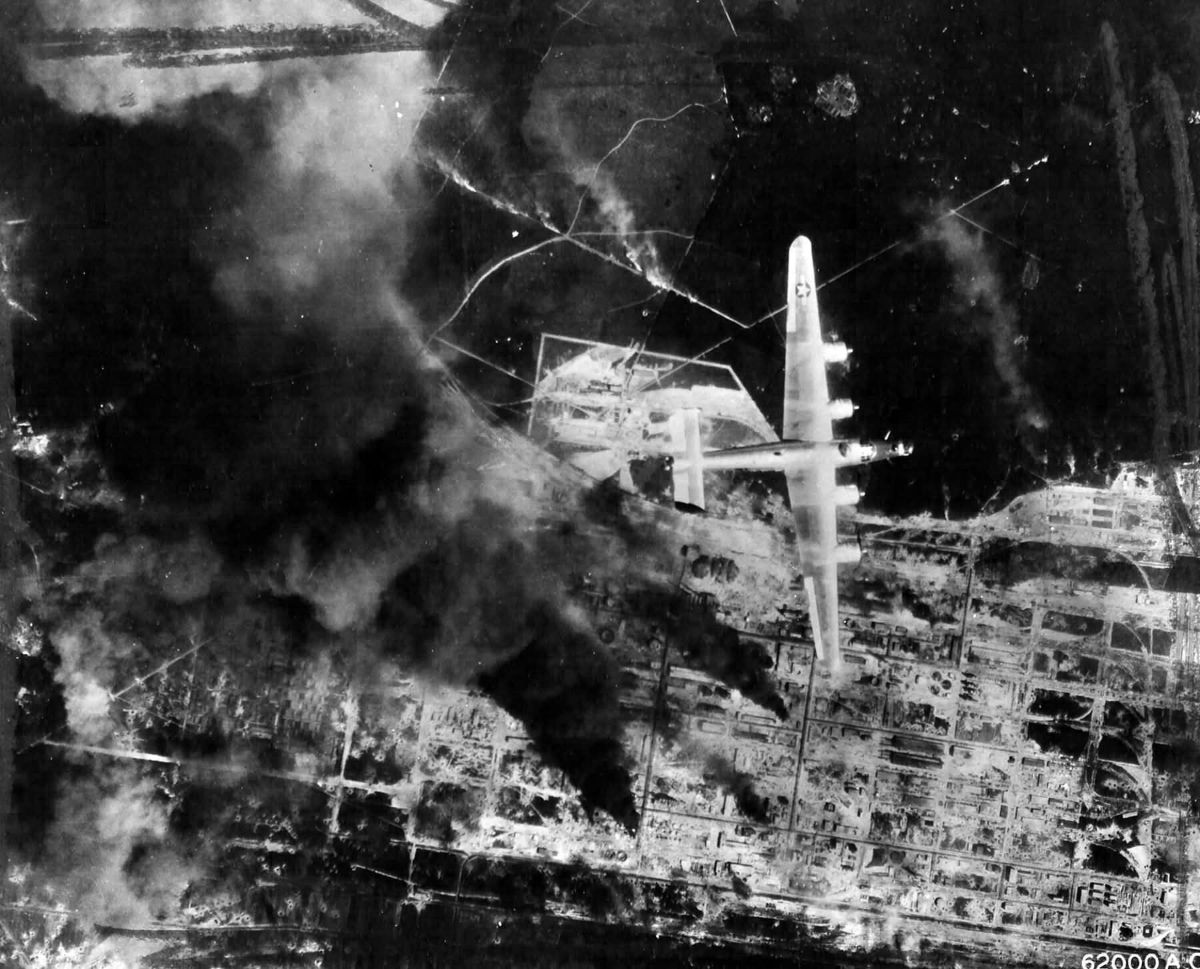
On May 12, 1944, the US Eighth Air Force flew bombers into central Germany with an unusual target list.
Last month, I wrote about how the US secretly handed control of AI to Germany in the dying days of World War II in 1945.
The TL;DR:
The US Third Army extracted 122 scientists from Jena in eastern Germany, and drove them south to a village called Oberkochen.
The operation subsequently handed the Carl Zeiss company a monopoly on optical precision that every single AI chip now depends on.
Every EUV lithography machine (the thing that makes the chips) on Earth runs on mirrors ground in Oberkochen — mirrors so flat that if you expanded one to the size of Germany, the highest surface variation would be 0.1mm.
If the Americans hadn’t moved Carl Zeiss to what became West Germany after the war, the Soviets would have had control, and the supply chain for today’s ~$500 billion AI industry might look very different.
Today I'm sharing the second part to this story; another quietly crucial commercial relationship between a German manufacturer and the Dutch ASML — the company printing billions of transistors onto the slices of silicon that enable all the compute powering AI.
By the end of this, you will understand why there’s a secret war playing out right now between Germany and the US.
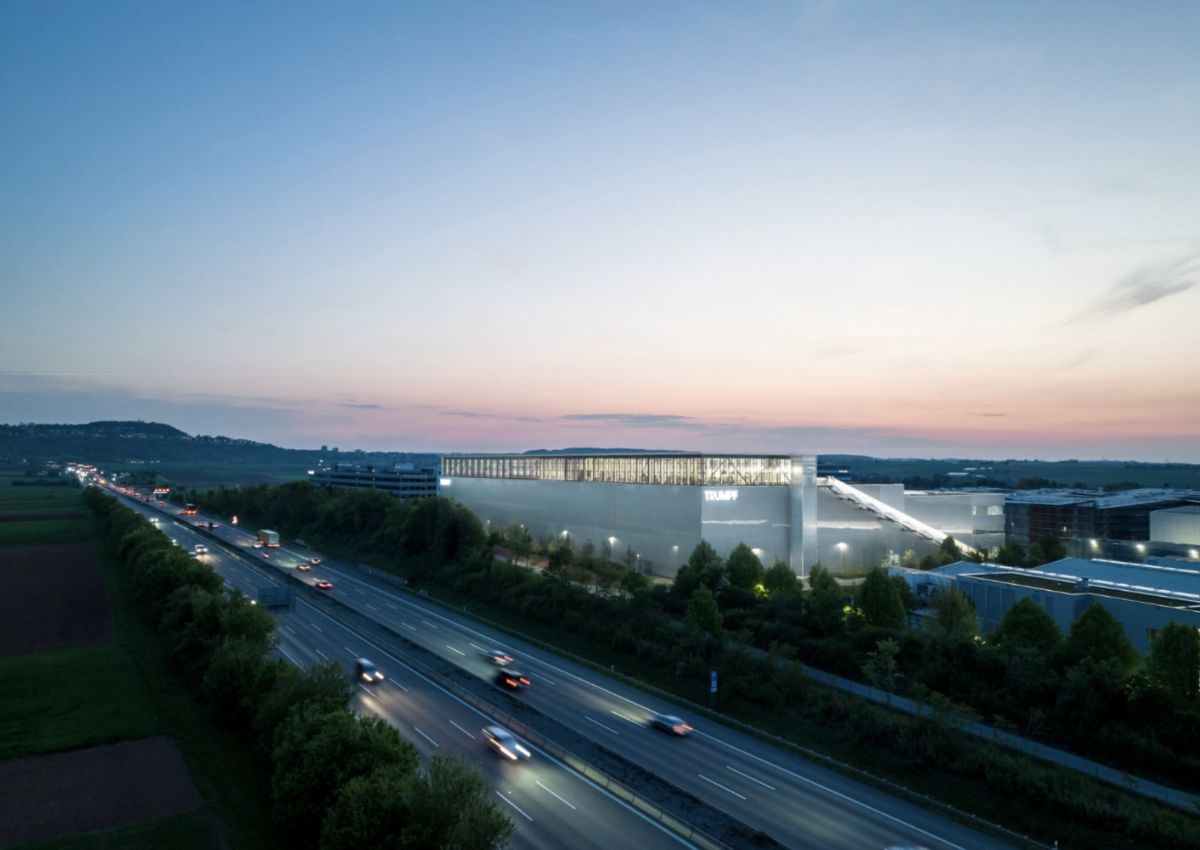
About 130km from Oberkochen, in a town called Ditzingen, there’s a company called Trumpf.
Yes, that’s ‘Trump’ with an f on the end.
While Carl Zeiss makes the mirrors, Trumpf builds the laser amplifier that makes EUV lithography possible.
Without it, ASML's $400 million chip-printing machines don't work.
Without those machines, Taiwan Semiconductor Manufacturing Company can't print the chips.
Without those chips, Nvidia's GPUs don't exist.
Without those GPUs, the AI industry is running on something substantially less impressive than what you might be using right now.
Here’s how the laser amplifier works.
A generator drops tin droplets into a vacuum chamber. Each droplet is smaller than the laser's own focus spot. A pulsed CO2 laser has to strike each one — 50,000 times per second — ionising the tin into plasma that generates the 13.5nm wavelength light EUV lithography requires.
To reliably hit something smaller than its own beam, Trumpf's engineers developed a pre-pulse: a low-power shot that flattens the droplet into a disc first, giving the main pulse a wider target.
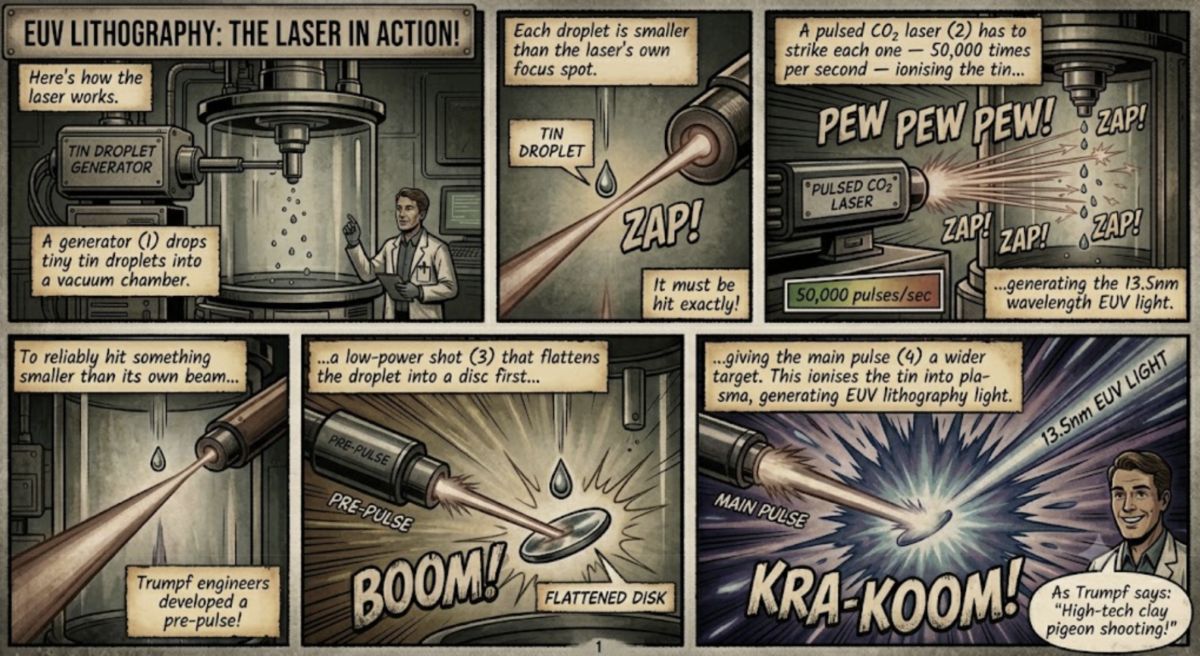
Trumpf calls the whole process ‘high-tech clay pigeon shooting’.
That's underselling it.
There is no other company on Earth that builds this laser amplifier.
So ASML has a single supplier for the most critical system inside the most critical machine in the AI supply chain — and that supplier is a privately held German company that very few investors know about.
When I wrote about Zeiss, I framed it as a hidden monopoly. That was correct, but incomplete.
Zeiss and Trumpf aren't two separate chokepoints. They're two legs of the same structure.
The third leg is ASML itself.
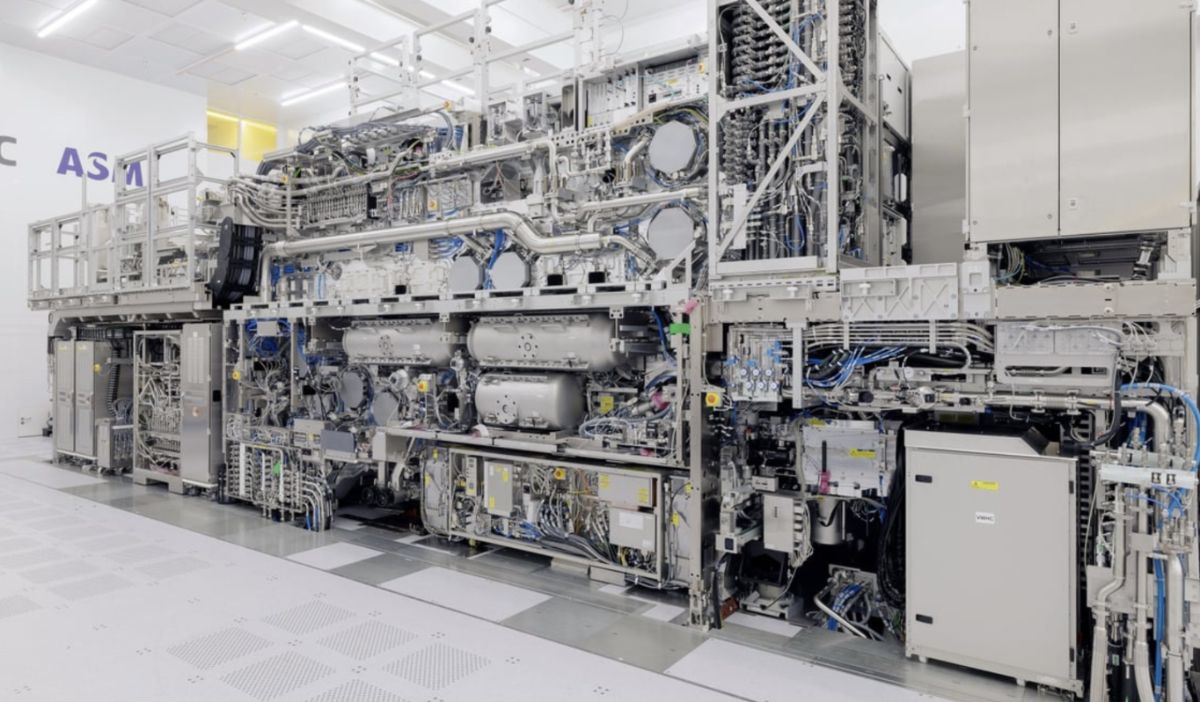
The Dutch company has taken a 24.9% stake in Zeiss's semiconductor division for roughly €1 billion, committed around €220 million in R&D support and another €540 million in investment support. IP is shared openly.
ASML executives have described the relationship as a ‘virtually merged company’.
So Zeiss, Trumpf and ASML together form a European tripartite commercial alliance through which the entire AI chip supply chain must flow.
ASML can’t make the chips without Trumpf’s lasers, and they can’t use those lasers without Zeiss’ mirrors.
But small-town Germany is a long way from Silicon Valley.
Which, if you’re the US, is a problem.
Here is what the US Army's 1945 Zeiss extraction actually accomplished: it moved the intellectual property and R&D capacity, but not the institution.
Washington got the scientists and the blueprints. But Carl Zeiss — as a company, as a culture, as a compounding institution — remained German.
So did everything that grew up around it, including Trumpf, founded a decade later up the road in the same state.
For the next eight decades, the US approach to these businesses was one of containment.
Export controls, diplomatic pressure, restrictions on what could be sold to whom.
It worked, mostly.
But it didn't change the fact that a family-owned company in a small German market town was the sole supplier of the most critical laser in the AI supply chain.
This year, the strategy has shifted.
The US Department of Commerce has committed up to $150 million to a startup called xLight, chaired by Pat Gelsinger — until recently the CEO of Intel.
xLight is building a free-electron laser specifically designed to replace Trumpf's CO2-on-tin-droplet system — with a government target of producing first test wafers by 2028.
This is a direct attempt to make the company in Ditzingen redundant, and replace it in the AI supply chain.
Simultaneously, Commerce Secretary Howard Lutnick has been pressing ASML — warning executives that Washington has evidence an EUV machine was diverted to China in breach of export controls.
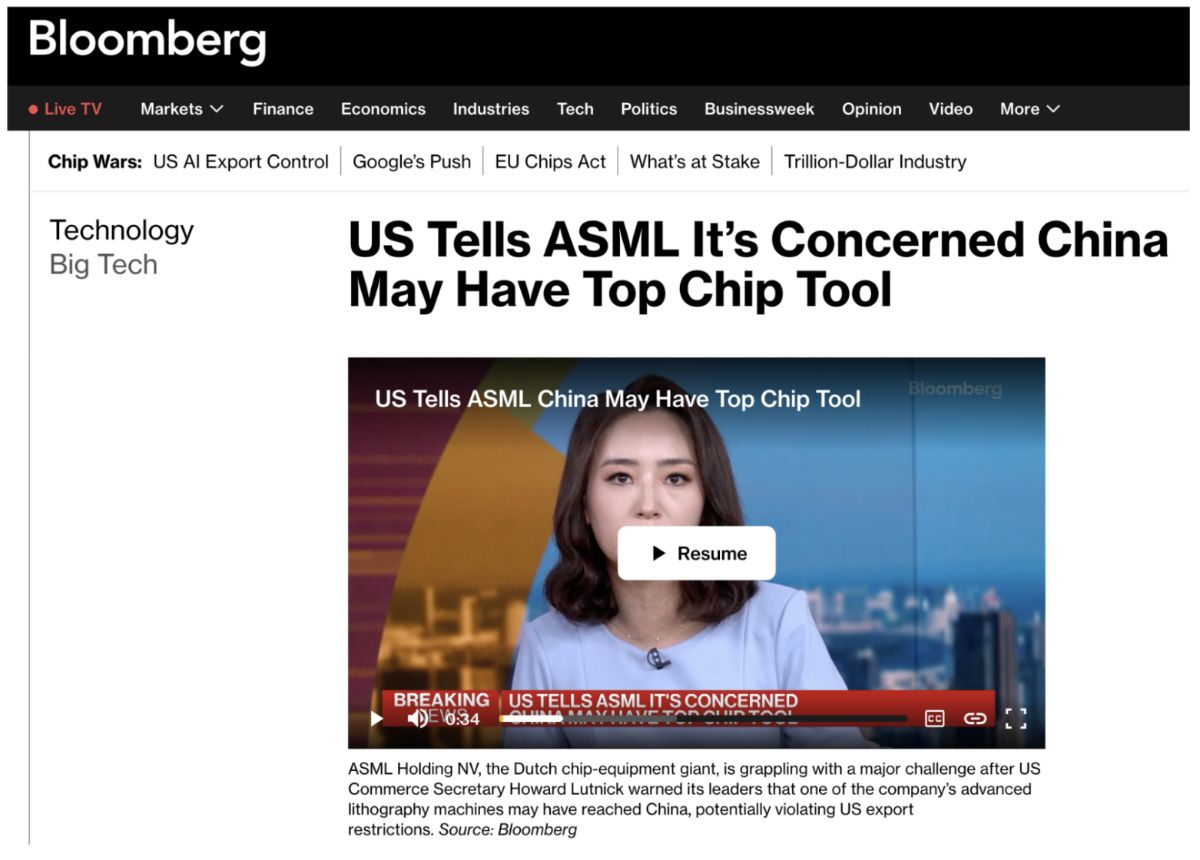
ASML denies. No EUV system has ever shipped to China, the company says. No evidence has been made public.
So there is pressure on the integrator from the outside. And an active attempt to replace Trumpf from the inside.
Bearing in mind that the US government took a 9.9% stake in intel last year...
You might say Trump is trying to trump Trumpf.
Seriously, though…
The 1945 operation used trucks and soldiers.
The 2026 version uses a federal cheque, a former semiconductor CEO, and an unverified accusation delivered in a private meeting.
The objective is the same — to wrest control of critical technology from a foreign power.
Trumpf's most recent numbers tell you something about what Washington is up against.
Revenue fell 16% in FY2024/25, to €4.3 billion. The EUV division specifically fell 23%, to €724 million.
In a listed company, like Intel, that's a restructuring conversation — activists circling, analysts demanding answers, a board under pressure to cut what isn't earning.
But for Trumpf, it's just a bad year.
Trumpf is 90% owned by the Leibinger family, chaired by Nicola Leibinger-Kammüller, with the remaining 10% held by the Berthold Leibinger Stiftung — a foundation.
There is no earnings call. No activist building a stake. No analyst asking whether the EUV division is earning its capital allocation.
The company that holds the laser monopoly at the centre of the AI supply chain has never once had to justify that position to a public market. They make their money from their clients, not from the capital markets.
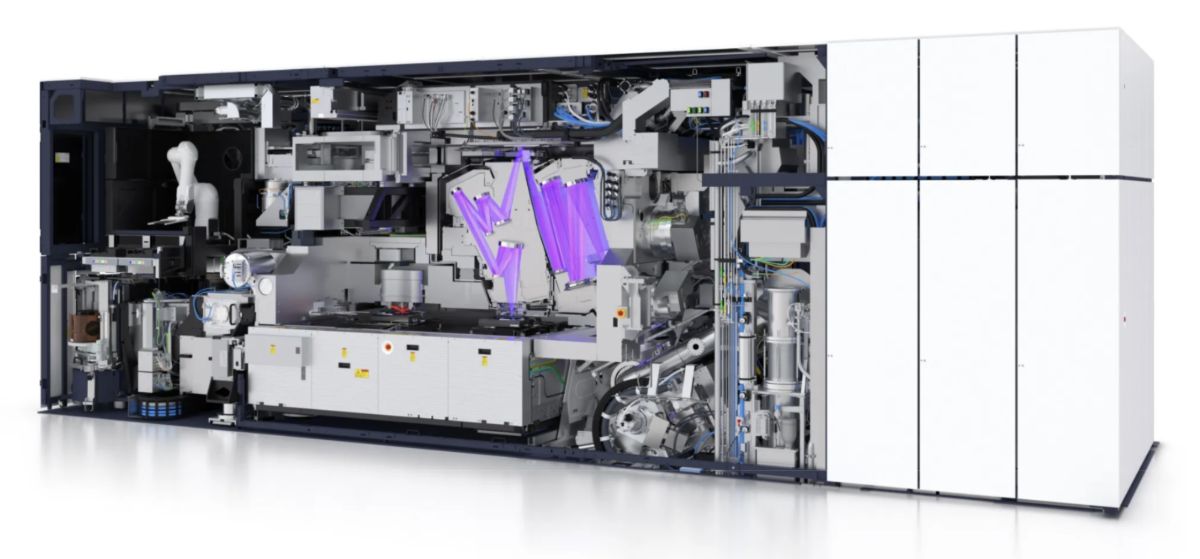
That's how they built their position in the first place. Trumpf spent the better part of two decades developing a laser that the market couldn't value, for a technology — EUV lithography — that most analysts considered commercially unviable well into the 2010s. A public board might have killed the programme. The Leibinger family didn't.
It was a similar story with Carl Zeiss. Nikon and Canon — both listed — assessed the atomic-precision optics problem and concluded it was physically impossible. Presumably because no public board could justify funding three decades of uncertain R&D to shareholders who needed the position to work this year.
Zeiss, insulated by its foundation structure, funded it anyway. It took thirty years. But it worked.
Washington is now trying to replicate sixty years of that kind of compounding institutional patience with $150 million and a two-year mandate.
So the secret war for the AI supply chain has been raging since 1945. It's never been louder than it is right now. And right now, its most important battle is being fought over a laser, in a town most people have never heard of.
This week's quote:
"The supreme art of war is to subdue the enemy without fighting."
— Sun Tzu
Invest in knowledge,
Thom
The Benchmark
Read more: The power of doing nothing as an investor.
Share: Forward this email to someone you know would appreciate it.
Connect: Add me on LinkedIn — I post about the stories and insights in the newsletter most days.
Become a reader:Subscribe to The Benchmark.
Get the next issue
The Benchmark lands free in your inbox every Thursday.
On May 12, 1944, the US Eighth Air Force flew bombers into central Germany with an unusual target list.
On a cold Monday morning in January 2000, two investors sat down at their kitchen tables. They each had $100,000 to invest.
On September 8, a 27-year-old British researcher sat on a park bench in San Francisco’s Alamo Square and announced on X that he’d quit his job.