


Is gold about to lose its 'precious metal' status?

What happens when gold is as common as copper?
Right now, about 371 billion kilometres from Earth, between Mars and Jupiter, there is a metal world.
Psyche 16 is a massive metallic anomaly; an asteroid made of iron, nickel and, crucially, gold.
How much gold? Potentially enough to completely upend human civilization’s notion of scarcity and value.
But that doesn’t matter, since this asteroid is so far from Earth.
At least it wouldn’t…
Were there not a NASA spacecraft speeding towards Psyche 16 at this very moment.

The Psyche craft will reach the metal world in 2029 — a century after the stock market crash that triggered the Great Depression.
When it does, the scarcity that has made gold the dominant store of value for more than 6,000 years could suddenly fail.
Because so far, ‘black swan’ events in the financial markets and economy have been confined to the terrestrial limits of Earth.
Never before have investors had to contend with the idea that the precious metal so long held as the, well, gold standard of scarcity and value, might have reached the end of its useful life.
So contend with this idea is exactly what we’re doing in today’s Benchmark.
A brief history of gold
While the exact moment humans found, or decided that, gold had value for them is lost to history, here’s what we know.

We first began working with and valuing gold in the Copper Age, about 6,000 to 7,000 years ago.
People in the Balkans and Mesopotamia (modern-day Iraq) were finding, hammering and casting gold by 5000 BC.
By 3100 BC the Egyptians had established a ratio between gold and silver (1:2.5).
In 1500 BC they made gold the official medium of exchange for international trade.
And 1,000 years after that, the Kingdom of Lydia (modern-day Turkey) introduced the world’s first gold coins.
Basically, for six millennia, gold served as civilization's ultimate store of value.
Because geological arduousness, which we’ll get to in a second, governed its supply.
When paper money emerged, in 7th-Century China, it functioned as a ‘receipt’ for heavy metal coins, allowing merchants to trade using the promise of gold's value without the physical burden of its weight.
For a long time, every dominant reserve currency linked directly to a specific weight of gold.
This ensured economic stability and global trust.

This was the gold standard.
Various fiat currencies abandoned the gold standard, with shocking consequences, over the decades.
But the biggest modern development in gold’s history was the 1971 Nixon Shock.
This marked the beginning of paper money floating freely, backed not by gold but merely by government policy.
Which brings us to gold’s current status in civilization.
As government-printed and backed fiat currency continues to lose its value, gold has increasingly become an inflation hedge.
The US Dollar is down 97% in purchasing power since 1913, for example:

Gold, on the other hand, priced in USD, is up about 14,000% since 1971:

Note the sharp rise in the past couple of years: That’s evidence of what has become known as ‘the debasement trade’.
As government debt has piled up, and the value of paper money has diverged more and more from gold, investors have been shifting capital out of fiat currencies and into hard assets.
All of which can be explained, pretty much, by one word; Scarcity.
The limits of scarcity
Every ounce of gold ever mined — roughly 216,000 tonnes — could fit into a single 22 sqm cube.
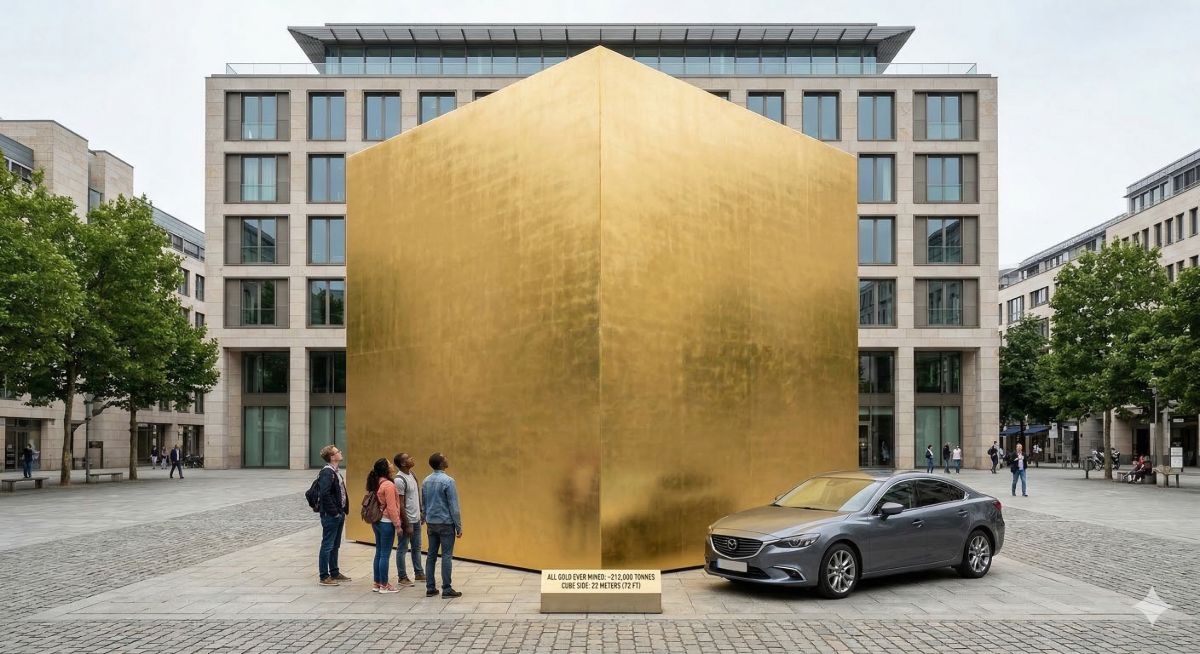
These 216,000 tonnes represent about 75% accessible gold on Earth.
I say accessible, because that gold is likely not even 1% of the total supply.
The other 99%, or more, is trapped in the Earth’s core.
The gold we can get to doesn’t actually come from Earth. It arrived here during something known as the Late Heavy Bombardment about 4 billion years ago.
This was when a wave of meteorites — some the size of Pluto — pummeled the planet, and deposited a gold, platinum, and palladium into its upper mantle.
In other words, all the gold you see in the world came from space.
And after 6,000 years of mining and producing, it’s more difficult than ever to get more.
Ore grades are in terminal decline. Gold discoveries are at 30-year lows. We now depend on new technology to access the little gold left.
This would be a perfect storm for gold investors.
Expanding fiat currency supply. Inflation. A rising debasement trade demand for hard assets.
Hence the near vertical increase in gold price over the past year or so.
But all this ignores the Psyche probe hurtling through space towards the metal planet.
The end of ‘gold standard’ scarcity?
Psyche 16 could be the cooled core of a long-dead planet.
Or it might be just a piece of cosmic rubble.
We won’t know until the probe arrives in 2029.
Either way, Psyche 16 is dense and rich with minerals.
For perspective, there’s probably only about 60,000 tonnes of gold left in the Earth’s crust.
Psyche 16 could contain 22.9 billion tonnes — about 100,000 times more, and at higher concentrations than you’ll find anywhere on Earth.
The kicker here is that Psyche 16 only has to have one part per million gold density to hit that number.
The actual density could be much higher.

That’s worth repeating: This asteroid might hold more than 100,000 times as much gold than humans have mined in 6,000 years.
We can’t know how long it might take to access and transport Psyche 16’s gold.
But we can reasonably assume that doing so would effectively collapse the ‘scarcity standard’ which currently accounts for gold’s value, price and status.
This could put gold on a par with industrial metals like copper or steel.
Which means investors in today’s debasement trade are betting on terrestrial scarcity only.
We currently have enough gold on Earth to fit in a single park fountain.
But Psyche 16 has enough gold to give every person on Earth three tonnes.
This metal world represents potentially the biggest supply shock in human history.
A celestial black swan
Nassim Nicholas Taleb is perhaps the world’s most accomplished expert on the subject of risk.
He’s spent decades studying randomness, probability and uncertainty.
Between 2001 and 2018, Taleb published a five-volume series of books on the nature of uncertainty, among which was The Black Swan.
A Black Swan is an event that is so rare, unpredictable, and impactful that it fundamentally changes the world.
The 1929 crash and Great Depression. The 2008 global financial crisis. The 2020 pandemic.
A Black Swan event has three key qualities:
Rarity: The event lies outside the realm of regular expectations. Nothing in the past can convincingly point to its possibility.
Impact: It carries an extreme, often global, consequence.
Retrospective Predictability: Humans concoct explanations for the event after the fact, making it seem explainable and predictable, when it was actually a total surprise.
Considering the potential impact Psyche 16 could have on humanity’s relationship to gold, scarcity and value, there’s a chance this is a Black Swan in the making.
For 6,000 years, the gold supply, and market, have been so stable, predictable and widely accepted that the precious metal has underpinned pretty much our entire financial history.
The idea that a single asteroid could deliver 100,000X the Earth's total supply is an event so outside the historical model of scarcity that it could effectively break gold as a store of value.
We might now be witnessing the final bull run for terrestrial gold — the end of a 6,000-year era.
This week's quote:
“Gold gets dug out of the ground in Africa... then we melt it down, dig another hole, and bury it again. Anyone watching from Mars would be scratching their head.”
— Warren Buffett
Invest in knowledge,
Thom
The Benchmark
Read more: How geographical determinism quietly controls the economy.
Share: Forward this email to someone you know would appreciate it.
New here? Subscribe to The Benchmark.


