
Bitcoin: 21 Truths in 2026
The last time I wrote a Benchmark focused on Bitcoin was May 21, 2024, almost two years ago.
In light of recent events, and the fact that many readers hold Bitcoin, it's high time we dig back into one of the most compelling financial stories of our, and possibly all, time.

On that day nearly two years ago, Bitcoin broke out 6% in a single day to hit a high of $71,946, having chopping around for weeks.
The day prior, the still-new US Spot Bitcoin ETFs brought in about $241 million, signalling growing institutional demand.
Twenty-four-hour trading volume was $46.9 billion.
Exchange reserves — the amount of Bitcoin available on exchanges as opposed to in digital wallets — had just hit a seven-year low.
MicroStrategy, as it was known back then, held just 214,400 BTC worth $15 billion.
One month earlier, the April halving had cut new BTC supply from 900 to 450 a day.
Here's the chart from that day:
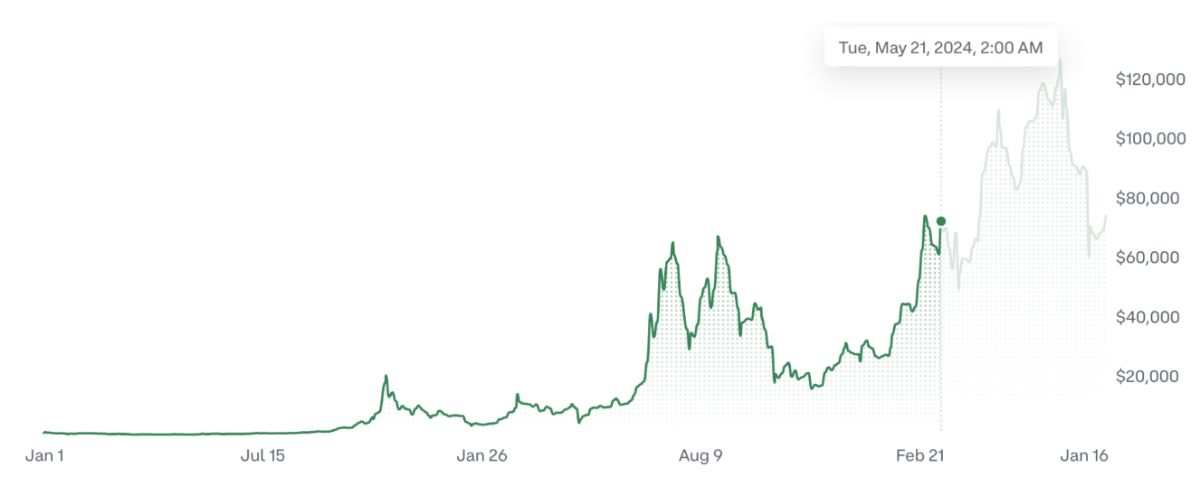
As I write this, Bitcoin is trading for $76,000 — just $4,000 higher than May 21, 2024.
Except this time, it’s not a strong one-day rally that’s led us here.
Having reached six figures for the first time in its history in December 2024, and going on to make a new all-time high of $126,198 10 months later…
Bitcoin is down about 40% from its high, having made a downside wick below $54,000 in February — a 57% crash from top to bottom.
Here's the chart now:

Exactly 23 months to the day of the previous Bitcoin-focused Benchmark, the daily ETF inflows are $238 million — almost identical to back then.
Daily trading volume is slightly lower (but not much), about $38 billion.
The number of Bitcoin available on exchanges is likewise barely different — 2.21 million, down from 2.3 billion.
These reserves have been trending down over the past couple of months.
Part of the reason for this is that one thing, besides the direction by which we’ve arrived at this 70-something thousand price range two years on, has changed significantly.
Same, but different
Early in 2024, Spot Bitcoin ETFs were new.
Institutional investors were initially slow to experiment and allocate.
In May 2024 the Bitcoin ETFs held $58.5 billion.
Today, they hold more than twice that.
BlackRock’s IBIT holds $55 billion on its own.
Strategy is no longer a software business with a Bitcoin treasury. It’s a fully-fledged Bitcoin company.
On May 21, 2024, they held 214,400 BTC worth $15 billion.
Right now they own 815,061 BTC worth $61.56 billion — about 3.9% of the total supply.
In fact, just yesterday, Strategy scooped up another 34,164 Bitcoin.

While the $2.54 billion that represents is no small amount of money, here’s the real reason I’m bombarding you with all these numbers today:
When Michael Saylor buys 34,164 Bitcoin, it destroys 34,164 individual investors’ chance of ever owning a single Bitcoin.
Bitcoin being so infamously volatile, the most popular pastime among investors, traders, critics and commentators alike is to argue over price.
Predictions, reactions, I-told-you-sos.
But what does any of that matter?
Because if I’d ignored the in-between facts, and just shared with you that Bitcoin was at $71,946 23 months ago, and ‘only’ a few thousands dollars higher today…
Then you’d be forgiven for thinking that nothing has changed.
But the reality is that a lot has changed in Bitcoin since then.
Which is why today’s Benchmark is going to focus on 21 truths about perhaps the most controversial investment asset in the history of capitalism.
This isn’t about where price might or might not go, or when.
It’s about the central promises and concrete realities of Bitcoin in 2026.
21 Bitcoin truths
The following 21 statements are either objectively true, or true to the best of my knowledge/research.
They span four categories:
1. Bitcoin’s physics & mathematics
2. The economics of human action
3. Financial sovereignty & risk
4.The future of the Bitcoin network
Should you have a differing opinion, or correction, on any of these, you’re welcome to write back to me by replying to this email.
Truth #1: There will only ever be 21,000,000 Bitcoin.
Unlike gold — where a price increase incentivizes more mining — Bitcoin's supply is inelastic. No amount of demand or human effort can create more than the code allows. As for the supply of dollars? Hard facts on that here.
Truth #2: Bitcoin will only ever grow more difficult to mine.
Every 2,016 blocks (roughly every two weeks), the Bitcoin network automatically adjusts how difficult it is to mine. If more people mine, it gets harder; if fewer mine, it gets easier. This ensures the network stays alive regardless of external economic conditions.
Truth #3: Bitcoin’s supply halves about every four years.
Every 210,000 blocks (approximately four years), the new supply of Bitcoin is cut in half. These halvings create regular supply shocks which cannot be reversed. In April 2026, we are in the era of 3.125 BTC per block. The next halving will be in mid-2028.
Truth #4: One can only create Bitcoin using energy.
To create Bitcoin, you must expend real-world electricity. This unforgeable cost connects the digital world to the physical world. It is impossible to print Bitcoin out of thin air, like fiat currency.
Truth #5: Bitcoin is the most powerful computer network in the world.
In terms of raw computational power, nothing else on Earth comes close to Bitcoin.
There are over 18,000 reachable 'full nodes' globally. These are small computers run by individuals that check every transaction. They ensure that even the most powerful government cannot cheat the rules of the network.
The interconnected clusters of NVIDIA-based AI data centres (led by Microsoft/OpenAI, Google, and Meta) constitute the second-largest concentration of silicon.

Truth #6: Bitcoin is neutral & permissionless.
Bitcoin does not care about race, religion, or politics. No bank can de-bank someone or stop them from sending BTC to anyone else.
Truth #6: Bitcoin lowers time preference.
Bitcoin rewards capital preservation over immediate consumption. This creates a structural incentive for long-term saving over impulsive spending.
Truth #8: One Bitcoin divides into 100,000,000 Satoshis.
This ensures the network remains functional for micro-transfers regardless of the price. Even with a high market exchange rate, the system facilitates small-scale commerce for billions of participants.
Truth #9: The Bitcoin ledger is transparent.
Every transaction since 2009 is recorded on a public blockchain. Anyone can audit the total circulating supply and verify the movement of funds in real-time without institutional permission.
Truth #10: Every Bitcoin is created equal.
There was no pre-mine or reserved supply for a central group when Bitcoin launched in 2009. Every coin in circulation was produced through the same mining process.
Truth #11: Bitcoin is the highest-performing asset in modern history.
Since its first trade in 2010, Bitcoin has delivered an annualized return (CAGR) exceeding 60%, significantly outperforming the S&P 500, gold, and real estate.
Truth #12: Bitcoin global adoption has reached the early-majority phase.
As of April 2026, approximately 500 million people worldwide own Bitcoin — roughly 6% of the global population. This growth rate mirrors the early adoption curve of the internet.
Truth #13: Bitcoin solves the ‘double-spend’ problem for digital property.
Before the Bitcoin protocol, digital information could be duplicated infinitely. Bitcoin created the first and only form of absolute digital scarcity.
Truth #14: Bitcoin transforms wealth into portable information.
Private Bitcoin keys can be encoded as a 12-word mnemonic phrase. This effectively means a user can transport any amount of value anywhere in the world simply by memorizing a string of text.
Truth #15: Bitcoin carries zero counterparty risk.
As a bearer asset, holding BTC in a private wallet does not rely on a third party to fulfill a promise. Unlike a bank deposit, its existence is not a liability on someone else’s balance sheet.
Truth #16: Bitcoin never sleeps.
Bitcoin trades 24/7/365. Without a central bank to manipulate the price or interest rate, the market constantly determines its value in real time.
Truth #17: Bitcoin is reaching institutional maturity.
In 2026, institutional entities and Spot ETFs hold approximately 6.5% of the total circulating supply. This reflects Bitcoin’s integration into the global financial infrastructure.
Truth #18: The Bitcoin blockchain is pure objective truth.
The ledger provides a sequential record of every confirmed transaction. It cannot be edited or erased. It serves as a permanent, mathematical archive of historical fact, accessible to all.
Truth #19: Bitcoin transactions are final and irreversible.
There is no central authority with the technical capability to reverse or undo a confirmed transfer on the base layer. This shifts responsibility to the individual user.

Truth #20: Bitcoin decouples the unit of account from political authority.
Just as the world eventually separated Church and State, Bitcoin separates the creation of money from the government. It functions as a neutral protocol for value — much like the laws of mathematics — that no nation can manufacture or manipulate.
Truth #21: Only about 0.1% of the world population can ever own 1 BTC.
While 94% of all Bitcoin is already in circulation, the final 6% will take another 110 or so years to distribute. Between lost coins, Satoshi’s stash, and massive institutional reserves (BlackRock, Strategy, etc.), it is mathematically impossible for more than 0.1% of the world's population to ever own one full Bitcoin.
There you have it.
This week's quote:
“If you don't believe it or don't get it, I don't have the time to try to convince you, sorry.”
— Satoshi Nakamoto
Invest in knowledge,
Thom
The Benchmark
Read more: Is this the reason why the 2020s feels like the 1940s?
Share: Forward this email to someone you know would appreciate it.
New here? Subscribe to The Benchmark.
Enjoyed this issue?
Subscribe to The Benchmark
Weekly insights on markets, investing, and portfolio strategy.