
Dear Reader,
The scoreboard for 2025 is in.
If you only read the headlines, you might think Nvidia and Bitcoin were the only games in town.
But if you look at the actual returns, a different story emerges.
For the first time in 15 years, the oldest asset on earth beat the newest ones.
Why?
Because 2025 started on narratives and promise, but ended focused on proof and pragmatism.
So in this, the first official Benchmark email of 2026, we’re talking receipts.
What signals did 2025 send us about stocks, Bitcoin, precious metals and — crucially — the world’s reserve currency?
Let’s start with one of my favourite investing charts of the year.
Gold: On top for the first time in 15 years

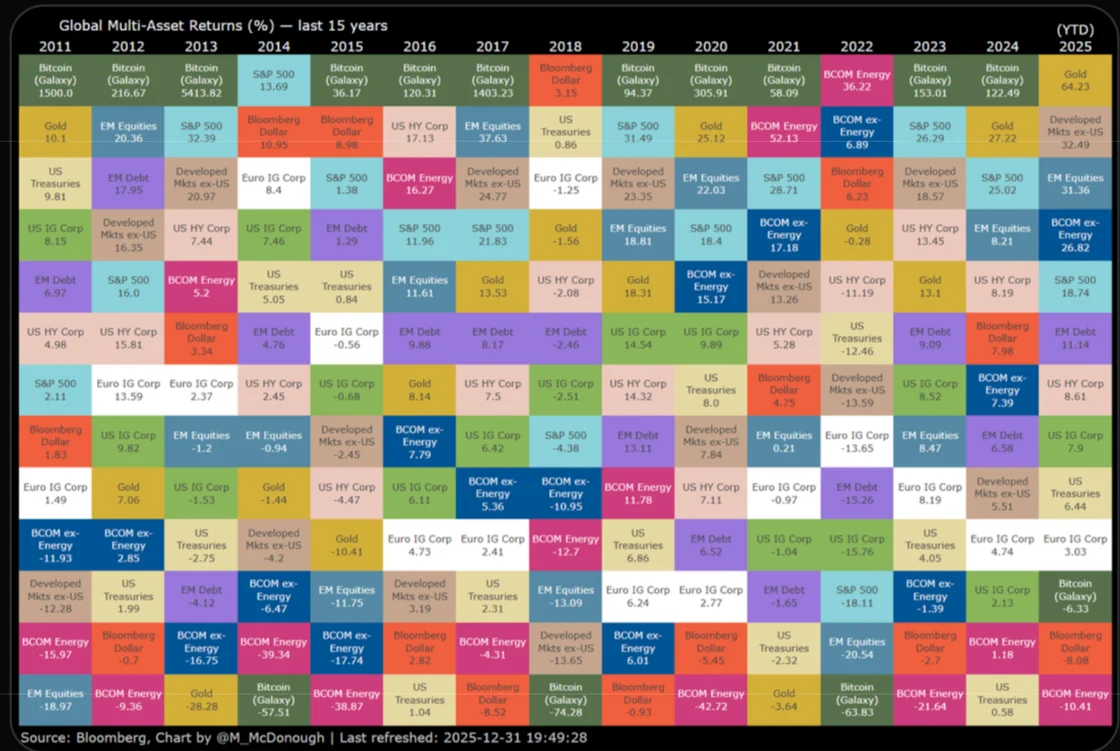
This is the Bloomberg readout of the best performing assets over the past 15 years.
You can see that for 11 of these latest 15 years, Bitcoin was the top performer.
Despite all the ‘Bitcoin is dead’ proclamations, ‘rat poison squared’ labels and criminal/fraud associations…
The numbers don’t lie: Bitcoin has been the strongest investment asset. No other has had more than a single year on top.
But look again, and you’ll notice that last year another asset — one which hasn’t graced the top of the charts at all in the previous 14 years — stopped Bitcoin from racking up a fourth hat-trick.
Gold came out on top, with a 64% return for 2025.
That’s more than double the performance of the next best asset last year, which was also perhaps not what you might have expected; developed markets excluding the United States.
And gold didn’t just thrash stocks. It thrashed the currency we price stocks in.
This is perhaps the most important signal from 2025, which we’ll come back to shortly.
Before we get into the reasons why, and where Bitcoin and AI stocks slipped to in the end-of-year rankings, let’s run through the list.
S&P 500 eclipsed, Bitcoin ends down after new ATH
If gold won the, er, gold medal in 2025, developed markets excluding the U.S. and emerging market stocks took silver and bronze, respectively.
The last time gold was on top? 2010.
Back then, the S&P 500 was just beginning its grinding recovery after the 2008 crisis and crash:
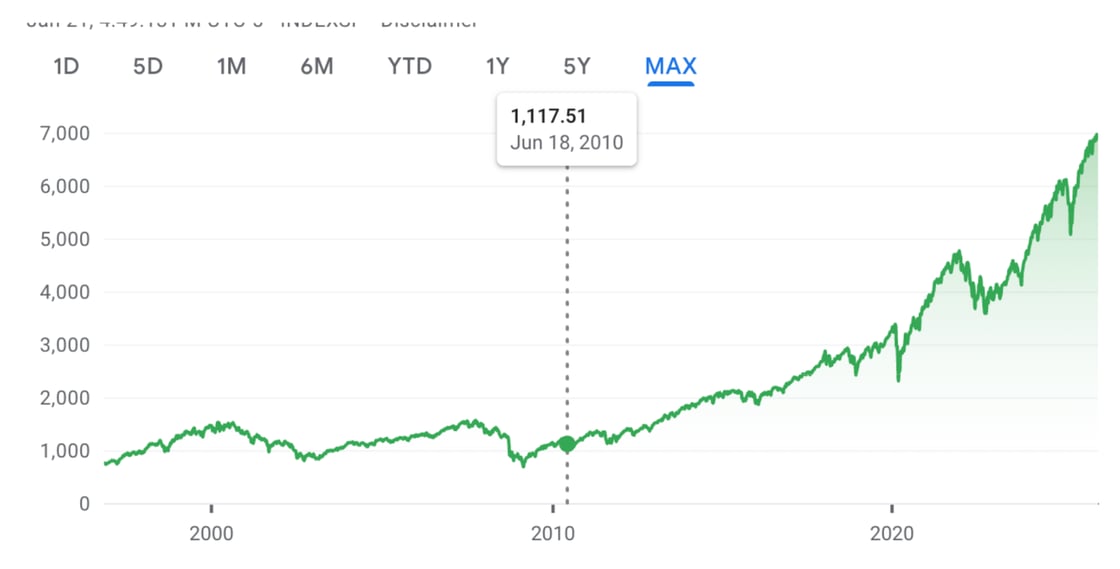
So gold being on top sort of made sense.
The subprime mortgage contagion had spilled into the economy and stock market.
Confidence and prices were low.
And Bitcoin?
In 2010 it had no established monetary value. It was effectively monopoly money, used only by a handful of cypherpunks and developers.
There were no exchanges until March.
That was the year in which Laszlo Hanyecz bought two Papa John’s pizzas for 10,000 BTC, valuing each coin at about $0.0041.
BTC ended 2010 trading for about 30 cents.
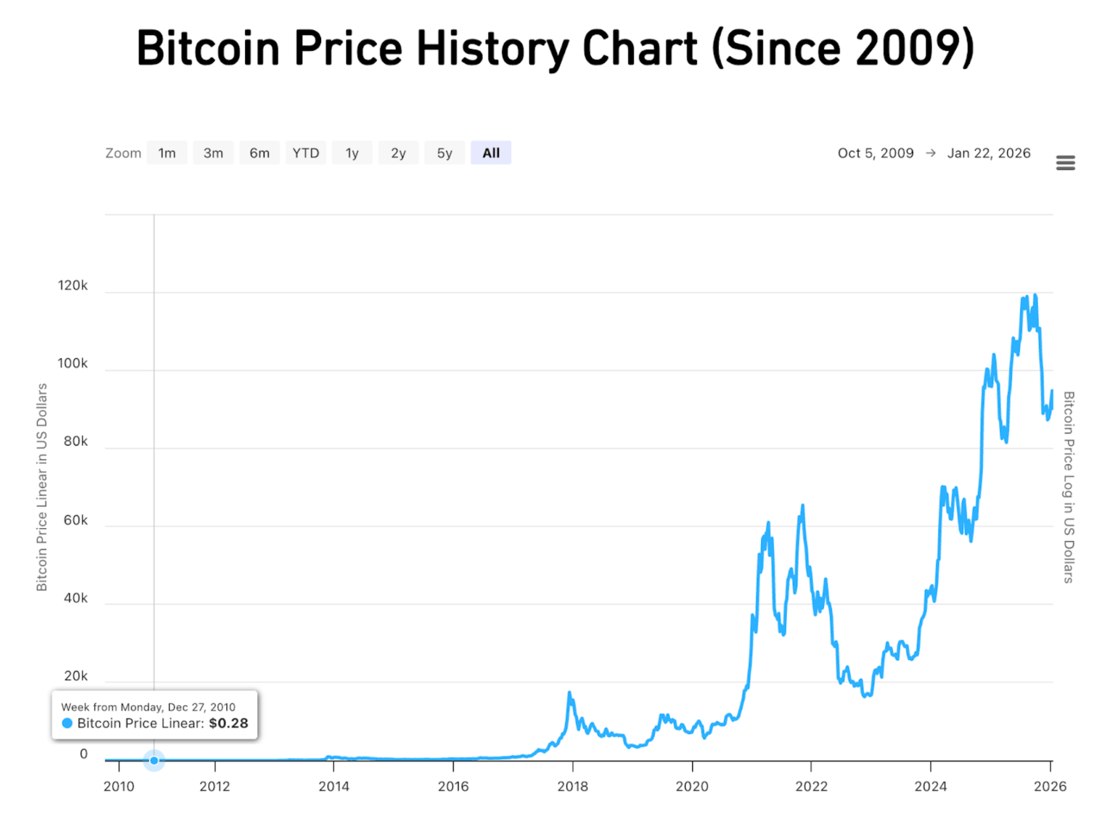
The following year, it entered the chart above for the first of its 11 #1 appearances to date.
But in 2025, the situation was significantly different.
Stocks made all-time highs.
Bitcoin did too, pushing past $120,000 for the first time in its short history.
So what happened?
Early 2025: Buying into promise
Heading into 2025, many investors were happy to buy into promise.
Take artificial intelligence.
The story of this transformative new tech, and the colossal companies developing and distributing it, functioned like an engine driving stocks higher.
Nvidia spearheaded the AI infrastructure theme.
Early in the year, the feeling around Nvidia and the other ‘AI darlings’ was one of almost reckless abandon.
Demand seemed infinite. Price irrelevant.
Headlines declared things like:
‘Nvidia Stock Forecast: Blackwell Will Steal the Show in 2025’ — Markets Insider, January.
And ‘Why Nvidia Stock Could Double in 2025’ — Nasdaq, January.
Investors felt that if they didn’t buy now, they might be left behind.
Bitcoin and crypto (because Bitcoin, as any Bitcoiner will gladly tell you, is not crypto) had a similar froth to them at the start of ‘25.
The White House had turned orange, with Trump’s ‘24 election win. There was finally a pro-crypto president in power.
Talk quickly turned to a strategic reserve.
Senator Cynthia Lummis introduced ‘The Bitcoin Act’.
Michael Saylor changed his company’s name from MicroStrategy to Strategy as it evolved into a full-blown Bitcoin treasury company, rather than a software company holding Bitcoin.
Bitcoin’s price flirted with $120,000.
The bold predictions — $250,000 by Christmas, and many far more optimistic — quickly followed.
So coming into 2025, AI and Bitcoin were riding high on a powerful narrative wave.
But that’s the thing about narratives; they can change fast.
Late 2025: Buying into proof
By the summer, anxiety began to creep into the market.
Investors began to question the seemingly infinite optimism.
The huge AI infrastructure investments — many between the key protagonists like Nvidia, Open AI and Oracle — which had fuelled the euphoria initially, began to raise red flags.
Blind optimism gave way to questions:
Is this sustainable?
How much demand will there really be for AI?
Is the market concentration in the AI theme setting us up for another dot com crash?
Is it even possible to generate enough energy to create all this new computational power?
This last question is something I’ll be covering in The Benchmark this year. Because it’s perhaps the most important story in 2026.
But back to the market getting the wobbles in 2025:
The persistent tariff news and geopolitical shocks didn’t shore up confidence.
Nor did the fact that U.S. debt grew another $2.2 trillion to hit $38 trillion.
And by Q4, Goldman Sachs and others noted a ‘rotation away from AI infrastructure’.
Capital fled the hardware builders (Nvidia) and looked for the software winners who could actually use the chips to make money — another big story to watch in 2026.
Probably no other single tech stock typifies this development than Oracle:

In early 2025, OpenAI signed a deal to rent cloud capacity from Oracle.
This was a $300 billion commitment over 10 years.
When Oracle reported earnings in September, they destroyed expectations.
The stock surged ~40% in days.
For a brief moment in September 2025, Larry Ellison surpassed Elon Musk to become the richest man in the world.
The problem was, this happened right at the moment his company started burning billions in cash to fulfill its OpenAI contract.
Oracle’s debt ballooned from ~$96B to ~$130B.
Its free cash flow flipped negative in Q4.
This is perhaps the most illustrative moment of the market’s shift away from narrative and towards fact in 2025.
As it did so, the NASDAQ shifted gear from ‘relentless rally’ mode and ‘sideways grind’ mode.
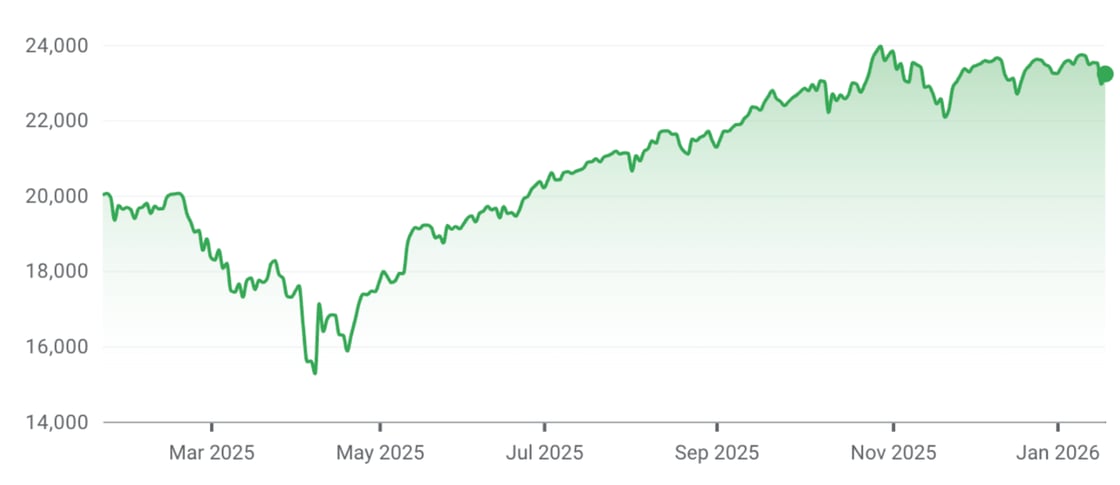
Bitcoin's trajectory was similar:
The promise of a new exponential golden age gave way to uncomfortable questions.
Investors who began 2025 optimistic about a seemingly certain parabolic move higher found themselves feeling strangely nervous when the BTC price did make its new ATHs.
Questions around the Bitcoin treasury model grew louder as more and more companies piled on the bandwagon, issuing debt purely to buy the digital asset.
The long-held belief in the ‘four-year cycle’ began to lose its hold on the market.
The realization that institutional adoption and favourable regulation doesn’t equal ‘number go up’ dawned.
And in the end, the year in which many were calling for $200,000, $300,000 and even $500,000, Bitcoin turned in a remarkably unremarkable 12-month performance:
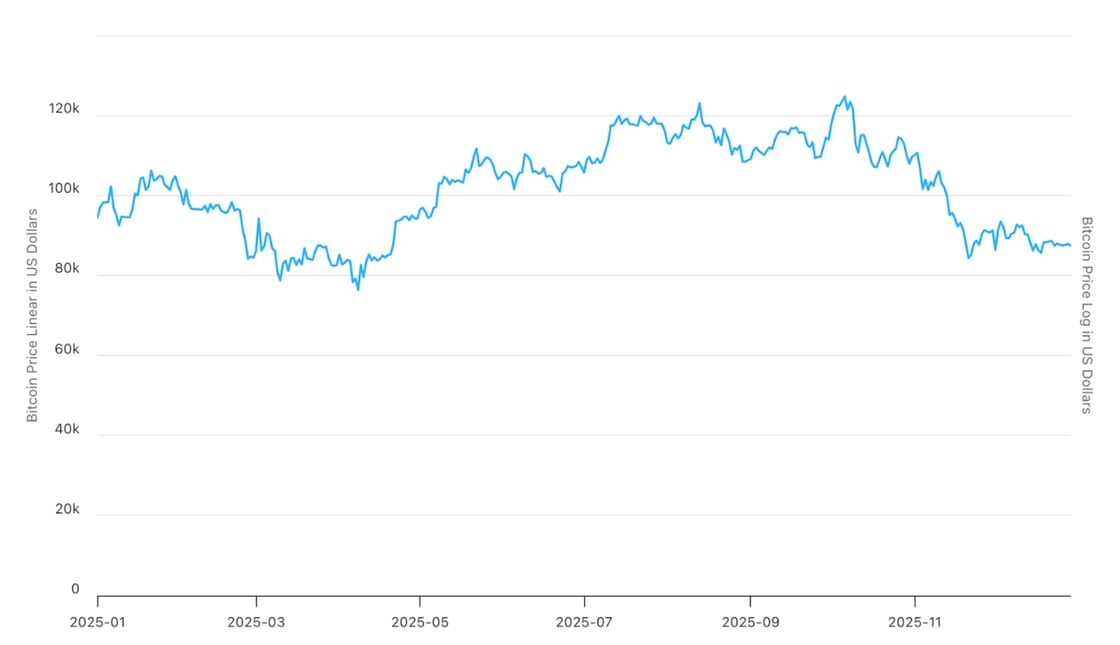
While the parallels are clear between the AI and Bitcoin stories in 2025, the bigger takeaway — as evidenced by the Bloomberg readout, is this:
A year that started out 'risk-on' became a flight to safety
The chart again:
Why did Gold win?
If stocks were at all-time highs, and the economy wasn’t crashing, why did investors rush into the ultimate safe haven asset?
Because 2025 was the Year of the Receipt.
We shifted from running on narrative to requiring proof.
It happened in tech and it happened in Bitcoin and crypto.
The hope for new highs and a fresh burst of exponential growth dissipated.
Stocks couldn’t keep ripping higher in the face of real-world concerns. Nor could digital assets.
Gold emerged as the best performer, because investors aren’t just anxious about the financial markets…
They’re worried about the world at large.
Debt and geopolitical risk is one thing.
But let me show you perhaps the most important — and perhaps most overlooked — chart of 2025:
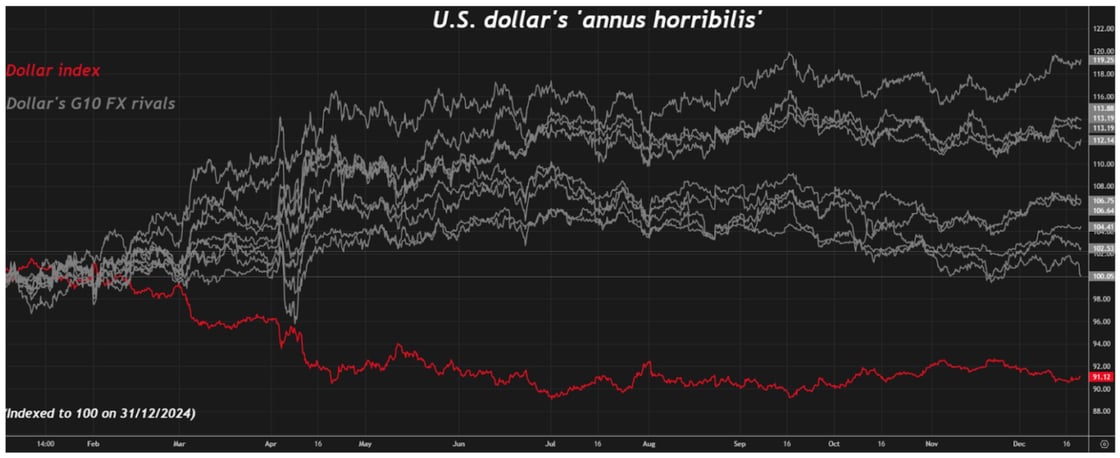
The U.S. Dollar had its worst year in nearly a decade.
While everybody was watching the stock and crypto markets…
The currency which they all use to measure those markets quietly crashed.
It explains everything else on the leaderboard:
Gold ripped higher because investors lost confidence in the Dollar.
International Stocks beat the S&P 500 because their currencies grew relatively stronger — the same was true for commodities.
The market buying gold could be interpreted as the market selling America.
Not because they feared a market crash, necessarily, but because the reserve currency itself lost nearly 10% of its economic power.
Currencies — especially reserve currencies — are another subject I write about in The Benchmark.
They’re not as exciting as the stock, crypto or precious metals markets, so they tend not to get the same coverage.
But as you can see, they’re important.
Here’s a piece on the history of reserve currencies I wrote earlier.
That’s your 2025 market wrap.
This week's quote:
‘Gold is money. Everything else is credit.’ — J.P. Morgan
Invest in knowledge,
Thom
The Benchmark
Share The Benchmark: If you've enjoyed reading, forward this email to someone you know would appreciate it.
New here? Subscribe to The Benchmark here. It's free and always will be.
Enjoyed this issue?
Subscribe to The Benchmark
Weekly insights on markets, investing, and portfolio strategy.