

Australian investors are facing one of the biggest changes to capital gains tax in decades.
In the 2026-27 Federal Budget, the Australian Government announced plans to replace the current 50% capital gains tax discount with cost base indexation and a minimum 30% tax rate on capital gains, starting from 1 July 2027.
In simple terms, the current system, where eligible investors can halve a capital gain after holding an asset for more than 12 months, is set to change. Instead, the cost base of an asset would be adjusted for inflation, and only the "real" gain above inflation would be taxable. A 30% minimum tax rate is also expected to apply to capital gains, regardless of the investor's marginal rate.
For investors, the immediate question is not just: "Will I pay more tax?"
It is also: How do I track all of this properly?
Because when the rules change, the quality of your records matters more than ever.

What Are the New CGT Rules?
Under the current rules, many Australian investors can access the 50% CGT discount when they sell an eligible investment they have held for more than 12 months.
For example, if you made a $40,000 capital gain, the 50% discount could reduce the taxable gain to $20,000. At a 37% marginal tax rate, that would mean roughly $7,400 in tax on the gain.
If the discount were removed without any replacement relief, the full $40,000 gain could be taxable. At the same 37% rate, that would be about $14,800 in tax. But that is not exactly how the proposed rules are expected to work.
Under the proposed rules, the 50% CGT discount would be replaced by cost base indexation, along with a 30% minimum tax rate on real capital gains accruing from 1 July 2027. The actual tax outcome would depend on inflation, the asset’s value at the transition date, the investor’s marginal tax rate, and the final legislation.
Same investment. Same gain. Potentially a very different tax outcome.
That is why investors are paying attention.

The Key Changes From 1 July 2027
Here is what we know so far from the Budget announcement:
- The 50% CGT discount would be replaced by cost base indexation for eligible CGT assets, including property and shares, held by individuals, trusts and partnerships for at least 12 months.
- Cost base indexation adjusts the purchase price of an asset for inflation (using the Consumer Price Index), so investors would only pay tax on the real gain above inflation.
- A 30% minimum tax rate is expected to apply to real capital gains accruing from 1 July 2027. This generally would not affect investors whose capital gains are already taxed at rates of at least 30%, and means-tested income support recipients, including Age Pension and JobSeeker recipients, are expected to be exempt in a year they realise a capital gain.
- Pre-CGT assets acquired before 20 September 1985 may no longer be fully exempt. Based on the Budget announcement, gains accruing after 1 July 2027 would become taxable.
- Superannuation funds are not expected to be affected. They would keep the existing one-third CGT discount.
- Investors who buy eligible new residential property builds would be able to choose either the 50% CGT discount or the new indexation and minimum tax method when they sell.
Transitional Rules for Existing Investments
For assets acquired before 1 July 2027 and sold after that date, the Budget announcement indicates that transitional arrangements would apply:
- The 50% CGT discount would apply to the portion of the gain accrued before 1 July 2027.
- Indexation and the 30% minimum tax would apply to gains accruing from 1 July 2027 onwards.
- Investors may be able to determine their asset's value at 1 July 2027 either by obtaining a valuation or using an ATO-supported apportionment formula.
These changes are proposed legislation and have not yet passed Parliament. The exact details may change through consultation and legislative process.
Why Parcel-Level Tracking Matters More Than Ever
A lot of investors think about tax in broad terms.
"I bought BHP for this amount."
"I sold some ETF units for that amount."
"My portfolio is up by this much."
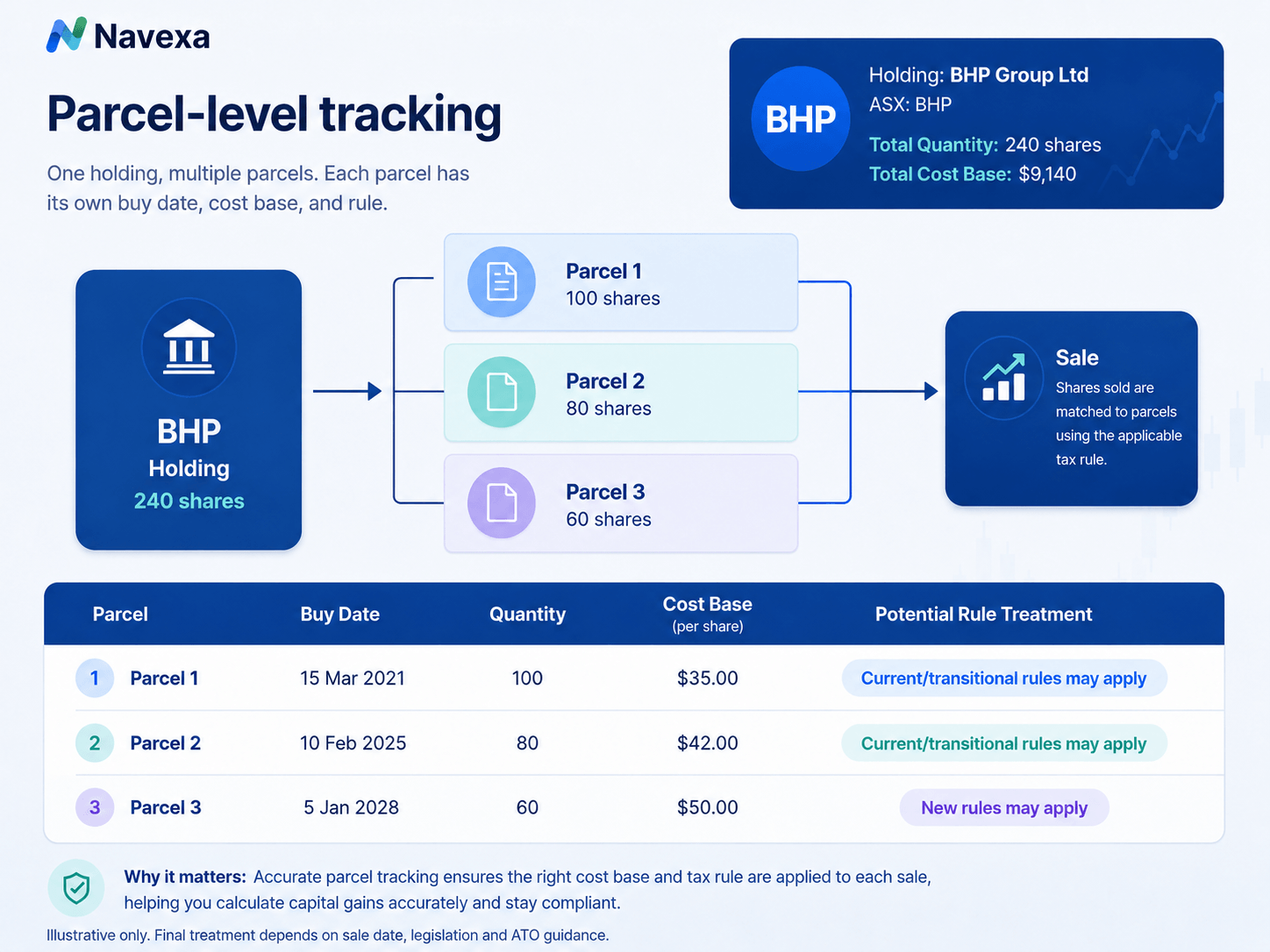
But capital gains tax does not work at the portfolio level. CGT is calculated down to the parcel level.
Every time you buy more shares, receive units through a dividend reinvestment plan, dollar-cost average into an ETF, or add to a crypto position, you create another parcel.
Each parcel can have a different:
- purchase date
- purchase price
- quantity
- brokerage cost
- holding period
- tax outcome
That matters because when you sell part of a holding, you may have flexibility over which parcels are treated as sold. Under the new rules, the parcel's acquisition date will also determine whether the old CGT discount, the transitional rules, or the new indexation method applies.
This is where tax outcomes can change dramatically.
Why Spreadsheets Will Struggle With the New CGT Rules
Spreadsheets can work when your portfolio is simple. But most real portfolios are not simple.
You may have years of buys, sells, dividend reinvestments, corporate actions, cost base adjustments, transfers, foreign currency movements and income events.
Then add a major CGT rule change with transitional arrangements.
Now you may need to know which parcels were acquired before 1 July 2027, which were acquired after, which rules apply to each parcel, how a sale should be calculated under the transitional regime, and what the asset's value was at the transition date.
That is a lot to manage manually.
This is the exact kind of complexity Navexa is built to help with.
How Navexa Helps Investors Track CGT Today
Navexa already helps investors track their portfolios at a detailed level, including performance, income, realised gains, unrealised gains and tax reporting.
One of the key advantages is that Navexa tracks investments at the parcel level. When you buy more of the same asset over time, each parcel is tracked separately. This matters when calculating capital gains, because the parcel you sell can affect how much tax you may owe.
Manual parcel selection is available on Navexa Standard, Premium and Pro plans. Basic includes CGT reporting, but parcel selection is available from Standard and above.
CGT Strategy Selection
Navexa supports different sale allocation strategies inside the Capital Gains Tax report settings, including:
- FIFO or first in, first out: sells the oldest parcels first
- LIFO or last in, first out: sells the newest parcels first
- Minimise Gain: selects the parcels that produce the lowest capital gain
- Maximise Gain: selects the parcels that produce the highest capital gain
- Minimise CGT: selects the parcels that produce the lowest capital gains tax outcome
- Per-holding overrides: lets you apply a different strategy to individual holdings
These strategies can create very different outcomes for the same sale.
The BHP Example: Why Parcel Selection Matters
In a recent video we shared with customers, we walked through a practical example using a BHP holding with multiple parcels created over time through buys and dividend reinvestments.
Using a default FIFO strategy, the capital gain was about $13,000.
But when the strategy was changed to minimise CGT, Navexa selected different parcels, including some sitting at a capital loss. That reduced the gain to about $4,300.
Same investor. Same holding. Same sale price. The difference came entirely from which parcels were selected.
The maximise gain strategy increased the gain to about $19,000. That might sound counterintuitive, but there are situations where an investor may want to realise more gains in a lower-income year or use a particular tax strategy based on their circumstances.
The key point is simple: how you sell can matter as much as what you sell.
How Navexa Will Evolve With the New CGT Rules
When tax law changes, investment tracking needs to change with it.
Navexa is already designed around the things that matter most for investment tax tracking: transaction history, parcel-level records, realised gains, unrealised gains, income, corporate actions and tax reporting.
At the time of writing, Navexa’s current Australian CGT reporting supports the existing CGT discount method. Support for any new indexation, transitional or minimum tax calculations will depend on the final legislation and ATO guidance.
As the new CGT rules become clearer and the legislation is finalised, Navexa will keep developing the platform to support the relevant changes.
That may include:
- supporting new calculation methods under the indexation regime
- handling the transitional rules for assets held across the 1 July 2027 boundary
- new reporting to help investors understand their position under the updated rules
- tools to help investors and their accountants assess realised and unrealised gains under both the old and new regimes
The point is not that investors should try to become tax experts overnight. The point is that your portfolio platform should keep up with the environment you are investing in.
Do Not Wait Until 2027 To Get Organised
The CGT changes are not expected to begin until 1 July 2027, but investors should not wait until then to clean up their records.
The better your records are now, the easier it will be to understand your position later, especially under the transitional rules, where the value of your assets at 1 July 2027 will matter.
A few practical steps investors can take today:
- Make sure all buy and sell trades are recorded accurately
- Check that dividend reinvestments are included
- Review cost bases for each parcel
- Keep brokerage and fee records
- Track realised and unrealised gains
- Understand which parcels make up each holding
- Speak with an accountant or tax adviser before making major selling decisions
Tax law can change. Your portfolio history cannot be recreated easily if the records are missing.
Navexa Will Keep Evolving With the Rules
The new CGT changes are significant. Some investors may pay more tax on future gains. Some may need to think differently about when they sell, which parcels they sell, and how they plan around income years.
But whatever happens, one thing will not change.
Navexa will keep improving to help investors stay on top of their portfolio tax obligations and options. As the legislation is finalised, the platform will continue evolving to support those changes, so investors can track their portfolios with more clarity, confidence and control.
Better records. Better visibility. Better reporting. Better tools to help you understand the decisions in front of you.
Because knowing what you own is only part of investing. Knowing what happens when you sell is just as important.
Frequently Asked Questions
Will Navexa support the new CGT rules?
Yes. As Australian tax rules evolve, Navexa will continue developing the platform to support relevant calculation methods, reporting requirements and investor needs as they become clearer.
Why does parcel-level tracking matter for CGT?
Because capital gains are calculated based on the specific parcels sold. Each parcel can have a different purchase date, cost base, holding period and tax outcome. Under the proposed new rules, the parcel's acquisition date may also determine which CGT regime applies.
Can I choose which parcels I sell for CGT purposes?
In many cases, investors can choose which parcels are treated as sold, provided their records support that choice. This can significantly affect the capital gain or loss realised on a sale.
Does Navexa support different CGT strategies?
Yes. Navexa supports sale allocation strategies including FIFO, LIFO, Minimise Gain, Maximise Gain and Minimise CGT, with the option to set per-holding overrides. This helps investors and their advisers compare different outcomes before making decisions.
When do the new CGT rules start?
Based on the 2026-27 Federal Budget announcement, the changes are expected to apply from 1 July 2027. However, these are proposed changes and have not yet passed Parliament. The final details may change through the legislative process.
Watch the Video
We recently published a video looking at what the CGT changes could mean for Australian investors, and how Navexa can help investors track their capital gains more clearly.
Want to see how your portfolio is positioned? Navexa helps Australian investors track performance, income, realised gains, unrealised gains and CGT strategies in one platform. Try Navexa today.
Disclaimer: This article is general information only and does not constitute financial, legal or tax advice. The CGT changes discussed are proposed legislation announced in the 2026-27 Federal Budget and have not yet passed Parliament. Details may change. Always speak with a qualified tax professional about your personal circumstances.